
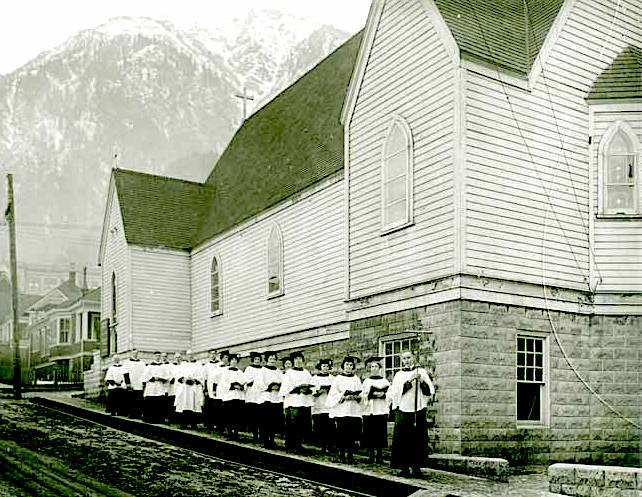
 The Church of the Holy Trinity is the oldest Episcopal Church in Alaska. Among local churches, it is second in survival age only to the Russian Orthodox Church of St. Nicholas.
Just as the Episcopal Church is closely interwoven with the history of Alaska, so Holy Trinity Church has been part of that history, associated with persons and events of significance.
It especially commemorates the almost 50-year legendary career of Bishop Peter Trimble Rowe, a figure of commanding public stature beyond his ecclesiastical achievements.
Juneau developed from the raw mining camp which sprang up in 1880 following the discovery of gold on both sides of Gastineau Channel.
It was four years before the first Organic Act was passed by Congress, giving Alaska a token civil government for the vast possession purchased from Russia in 1867.
For almost two decades, American churches accepted the general myth that Alaska was an uninhabited frozen waste land. There was little attempt to send missionaries; although the Church of England, in Canada, had followed the Hudson Bay Company into the Upper Yukon River area in 1861.
The Organic Act of 1884 provided for a governor, courts, and schools. The remarkable Presbyterian missionary. Dr. Sheldon Jackson, assumed the post of education agent, but recognizing the scope of the task turned to the missionary board of other churches for assistance.
An informal regional agreement was worked out to present overlapping. With but three missionaries, stationed in widely separated places, the Episcopal Missionary District of Alaska was constituted in 1892 and a Bishop for Alaska elected in 1895.
By this time, the necessity of expanding the work of the Church to include the miners, settlers, and other whites was obvious. The discovery of gold was soon to attract hordes of people.
Peter Trimble Rowe, first Episcopal Bishop of Alaska, was born, educated, and ordained in Canada. He came to the United States in 1882 to take charge of a mission in Sault Ste. Marie, Michigan, and became an American citizen. His experience in Canada and northern Michigan helped prepare him for the rugged life ahead. Bishop Rowe received his appointment in 1895 and continued a dynamlc involvement in Alaska life until his death in 1942.
Arriving aboard the steamer, "City of Topeka", in March 1896, Bishop Rowe was accompanied by the Rev. Henry Beer from Michigan, who would stay in Juneau. Mrs. Rowe and their two sons waited in Tacoma with Mrs. Beer until there would be a place for them to live. The "City of Topeka" was crowded with more than 200 men, their sled dogs, and a few women bound for Circle City. The Bishop held services aboard ship on Sunday, and all who could crowd into the saloon did so to hear him.
The previous year Reverend R.D. Nevins had been sent ahead to Juneau by the Bishop. He had gathered several families for services, organized Sunday School classes, and a ladies guild.
It was these first services conducted by Dr. Nevlns in the old Presbyterian log cabin church, on Trinity Sunday in 1895, which suggested the name for the new congregation. The collection of frame and log buildings and muddy streets, while not attractive to newcomers, indicated Juneau's future. Gold Stamp mills were operating in the Basin and at Treadwell Mine.
The Sisters of Ann, who arrived in 1887 had started a hospital and school; the Rev. and Mrs. Jones of the Presbyterian Church operated a mission school. There were two weekly newspapers, hotels, a doctor, large business establishments, and a great many saloons. Juneau was crowded with miners getting outfitted for the coming summer. It was impossible to rent a house.
Bishop Rowe wrote, "The present population is about 1800 whites with some hundreds of Natives. Saloons and variety shows are numerous and alarmingly active and seductive. Mr. Beer and I lodge together in one small room, cold and bare, and are obliged to skirmish around for meals...to do our writing, we are obliged to resort to use the small quarters occupied by the Rev. Dr. Nevins...0ur mission here is to the white. It is the only mission to the white population in this part of Alaska...we shall be obliged to build...as soon as possible."
Leaving Rev. Beer in Juneau, Bishop Rowe then made his way north for his first inspection of Alaska. Rev. Beer set to work to build a church and rectory. Lots 8 and 9, Block 15, were purchased for $375. Contracts were let by Trustees R. D. Bently, J. J. Rutlege, C. D. Taylor, and J. Montgomery Davis, with builder George E. James. The rectory was quickly finished and Mrs. Beer arrived with the Rowe family on their way to Sitka.
The new house faced Gold Street behind the church, and cost $1,400. The Alaska Searchlight reported, "This house is one of the best residences of Juneau, and Mr. James, the builder, is to be congratulated on the style and the finish of the structure."
There was a social at the rectory May 19, 1896, to welcome Mrs. Beer. Rev. Beer and a few volunteers then assisted James with the building the church according to plans furnished by the Bishop. Labor costs were $700. Including materials the total was $2,600 for the church. As there was no kiln to dry the spruce lumber commonly used, high quality fir was imported from Tacoma, testifying to the quality construction.
On Saturday, July 25, 1896, the Searchlight advised, "The new Episcopal Church in Gold Street, which is to be known as Holy Trinity Church, is now so far completed that it is being used for services on Sundays. Stoves, seats, and other necessary articles of furniture have been put in the church, and the rector wishes the people of Juneau to bear in mind that it will be open to all every Sunday at 11 a.m. and 8 p.m. The seats are free, and it is earnestly desired that worshipers may crowd the 'Courts of the Lord's House' every Lord's Day. This beautiful building has been erected at considerable expense for the benefit of the people of Juneau, and only by attending its services can that benefit be attained."
Bishop Rowe, meanwhile, landed at Dyea, hired a helper and packed over the Chilkoot Pass. He whipsawed lumber, built a boat, and made the hazardous trip down the Yukon to Forty Mile and to Circle. During the journey, he conducted services everywhere and was an inspiration and help to the many men struggling to the Klondike and interior gold fields.
When he returned, by way of St. Michael in October, he reported to the mission board: "I found the church and the residence of the missionary completed and occupied. They do give us credit. Mr. Beer gave much personal work in their erection. It is a difficult place to get insurance. Fortunately, I succeeded... as a few weeks after, the church caught fire from cinders carried by the terrible Taku winds, which proved the wisdom of insuring...the moral condition...is not conducive to religious work. The population is transient, it is the center and metropolis of a large mining district sure to develop. Its future is certain. It is a good outfitting place for the Yukon. Meanwhile, it is a trying field for the missionary; he fills no enviable place, and well deserves the prayers, cheer, and aid of our friends. A guild and Sunday School flourish. A class of four was presented to me for confirmation."
That summer a medical missionary. Dr. A. J. Cambell, a friend of Bishop Rowe's, arrived to work in Douglas, where he later established St. Luke's. The early registers of Holy Trinity reflect the events of the day: weddings, baptisms, confirmations, and many burials. Some members of those original families of the first congregations still live in Juneau.
One instance, reported from newspaper files: the law-abiding citizens were shocked by the killing of Deputy Marshall Watts, by an escapee of the Jail in January 1897. "The most splendid funeral ever held in Juneau" took place in the new church. Bishop Rowe, who was visiting, used the occasion to suggest mercy for the wrong-doers. After an elaborate procession to the cemetery, the mourners organized a posse, and heavily armed, went out in three boats and peacefully apprehended the fugitives on Admiralty Island.
Bishop Rowe traveled north again in 1897 by reversing the Yukon route. Coming out in the fall across Chilkoot Pass, he met the tide of men going into the Klondike. When he saw the new city of Skagway which had sprung up, he recognized the necessity there.
Accordingly, both Rev. Beer and Dr. Campbell were assigned to Skagway, establishing St. Saviour's Church. The Juneau and Douglas churches were served, sporadically, for the next few years from Skagway. On his third trip north in 1898, Bishop Rowe again made the Chilkoot trek, this time in the company of thousands of gold seekers. Back in Sitka that winter, plans were made for the building of St. Peter's-by-the-Sea, and for a Bishop's residence, called the See House.
For the next decade the work in Alaska continued as what Bishop Rowe was to describe as "a mission to a movement, a procession." The Bishop and his clergy, some with families, did their best to follow the miners as they moved from old strike to new, establishing missions, building churches and hospitals where they could in the camps.
1903 saw the coming of another missionary to Alaska, who was to have a vital influence in Juneau; though not until 19 years had elapsed. This was the Rev. Charles E. Rice, who was stationed at Circle. In 1901, nine victims of the wrecked S.S. Islander, were burled from the church.
By 1906 the capital of Alaska had largely moved to Juneau from Sitka. The Rev. C. E. Renison arrived in 1910, and from that day onward the church has had a continuous ordained ministry. This was a peak period for mining, both at Treadwell Mine and the Alaska-Juneau operations.
Trinity services were also held weekly at Thane, reached by ferry; and Perseverance Mine, by wagon on the mountain road where an active congregation provided a church school, altar guild, and choir.
The establishment of territorial status for Alaska and provision for a legislature in 1912, meant even more families residing in the capital city. Continued Improvement was necessary for Holy Trinity Church.
A basement was installed, with a furnace replacing dangerous wood-burning stoves. The interior was refurbished, particularly with the addition of a series of paintings done by Mrs. J. Montgomery Davis, an accomplished English artist who had studied art in Europe. She came to Juneau as a visitor in 1891, and met and married Mr. Davis. An organist, she also taught Sunday School classes in the old log cabin church. She and her husband were among those most instrumental in establishing Holy Trinity.
The cave-in of the Treadwell Mines in 1917 and the following year, the wreck of the Princess Sophia in Lynn Canal and the deaths of hundreds, including Mr. and Mrs. Walter Harper, missionaries from Fort Yukon, are sadly reported in the Register. The Treadwell disaster diminished the population at Douglas.
When a bridge to the island was finally built in 1935, the two congregations united. The last services were held at St. Luke's in December of 1951.
The war years of 1917-1918 saw the addition of memorials to church furnishings, but the attractive rustic character of the original interior remained. In 1915, the rectory was extensively repaired and a new rector.
The Rev. Guy D. Christian, arrived from St. Mary's Church in Nome. In 1918 he became the first Dean of Holy Trinity Cathedral, so designated by Bishop Rowe. By this time, the Bishop had moved his residence to Victoria, B.C., and his office to Seattle.
In his absence, the church in the capital city was made the pro-cathedral; later when a new bishop chose to reside in Nenana, and then in Fairbanks, this was dropped, in 1944.
In 1921 the Rev. Charles E. Rice returned to Alaska to become second Dean of Holy Trinity Cathedral, a post he filled ably for 22 years. Dean Rice firmly laid foundations of the church that is today, both on composition of the congregation and improving the physical plant.
According to old timers, the Dean and his boys were regularly seen repairing, painting and maintaining the church and old rectory. Almost all of the shingles on the roof, one of the steepest in Juneau, bore his fingerprints, some said. Unlike the church, the rectory had deteriorated and was inadequate.
In 1940, the Kohlepp residence on the northeast corner of Fourth and Gold was purchased, and the old building was dismantled.
In 1942, in his eighty-sixth year, Bishop Rowe died. He had kept busy almost to the end with a trip north in the summer of 1941. He last visited the Church of the Holy Trinity in 1937. There are many memorials in his honor, and in the hearts of the many lives he touched.
The lovely "Denali" window in the Holy Trinity Church, in memory of the Bishop, was executed and donated by artist Jessie Van Brunt of New York.
In 1929. Dean Rice retired in 1943, but remained in the territory ministering to several vacant churches in southeast Alaska during the war years and after. The Dean died in 1952.
The Rev. W. Robert Webb succeeded Dean Rice in 1944 when the cathedral was returned to the status of a parish church.
Four years later the Rev. Samuel A. McPhetres came to Juneau. Inspired by his vision and enthusiam, the church moved forward in vital ways, culminating in "aided parish" status in 1955, and the building of a parish hall and extension of the church building in 1956.
A profound sense of loss was felt throughout the entire community with the sudden unexpected death of the Rev. Mr. McPhetres in June, 1959, and the laity of the church carried on for six months until a rector could be found.
The new parish hall was named McPhetres Hall in his honor, and has since filled many community needs. Several times it has been used as classroom space when there have been crises in the schools. Other community service organizations have been grateful for the use of the hall. He was replaced by The Rev. Mark A. Boesser.
In 1961 the Rev. Walter W. Hannum arrived from Fort Yukon to serve as Associate Rector, considerable time to the study of alcoholism in Alaska. He also gave It had become obvious that the Kohlepp house was not much younger than Rev. Beer's original "splendid residence" of 1896, and it, too, needed replacement.
The parish found it necessary to demolish the old building and built an attractive new rectory on the corner of Fourth and Gold in 1966. Father Hannum returned north that year, and the Rev. Charles H. Eddy, a new graduate of Virginia Theological Seminary, joined Father Boesser.
His particular interest were in activities for teenagers and young adults, both in the parish and the community, as well as regional community action programs. Father Eddy went on to St. Mary's in Anchorage in 1968, and in 1972 Father Boesser resigned as rector and, following a year of special study, became Diocesan Coordinator of Developing Programs for Ministry.
The Rev. John B. Bentley, appointed in 1930 as Archdeacon of the Yukon and as Suffragan Bishop to assist Bishop Rowe, in 1943 was named second Bishop of Alaska. In 1947 he became Vice President of the National Council.
In November 1947, the Rev. William J. Gordon, Jr., was elected third Bishop of Alaska. Bishop Gordon traveled all through the parishes and served the Church in Alaska by airplane, which he flew when he could, or by dog team, just as Bishop Rowe had, as well as by steamers, automobiles and any other mode of transportation he could find. In 1974, the Right Rev. David R. Cochran was elected the fourth Bishop of Alaska.
At Holy Trinity the present rector is the Rev. Dale G. Sarles who came with his family from Valdez in November of 1972. When fires in 1973 and 1974 destroyed both Resurrection Lutheran and the Mormon Church, Holy Trinity share facilities with the Lutherans for the two years it took them to rebuild.
The Episcopal Church in Alaska commemorated the 100th anniversary of the arrival of the first English missionary at Fort Yukon in July of 1961, and is now in its second hundred years.