
The Ralph Martin House, 128 Dixon Street, sits on the west slope of Telephone Hill on Lots 5, 6 and 7. The 1894 plat map of the Juneau Townsite shows George Harkrader owning Lots 5, 6 and 7. City tax rolls indicate that Harkrader and his estate owned the property until 1920.
Harkrader was an early miner and Juneau settler. He staked a lode claim on Mount Roberts in December 1880 and the following year located a quartz and placer claim in the Silver Bow Basin (DeArmond 1967; Alaska Monthly 1907). The 1914 Sanborn map shows a home, possibly Harkrader's, on the north half of Lots 5, 6 and 7 next to the West Second Street right-of-way (Hurley 1983). The house was removed in the mid-1930s. Prior to his death in 1915, Harkrader ran unsuccessfully for the city council as a Socialist.
Local building contractor James Larson built the house for Ralph Martin and Mildred Martin in 1931 (Carrigan, Johnston 1983). Martin came to Juneau in 1917 and was employed by the Alaska Electric Light and Power Company for 25 years until his death in 1947 (Bayers Collection 1947). The ornate lighting fixtures installed throughout the house reflect Martin's employment with the utility.
The Johnstons purchased the house from Mildred Martin in 1950. Joe Johnston operated a hardware business in downtown Juneau while his wife was a federal employee for 25 years (Johnston 1983). In 1981 she sold the house to Homan-McDowell and moved into the basement apartment.
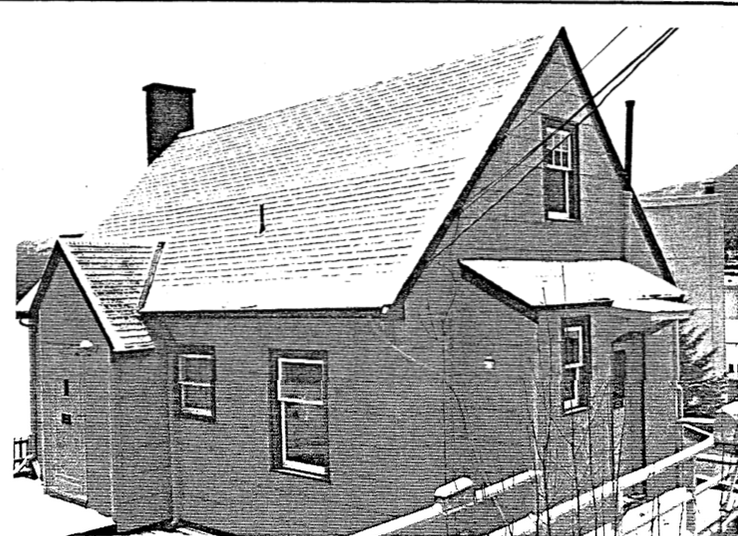
In 1984 it was owned and occupied by Homan-McDowell, economic and management consultants. Former owner, Edna Johnston, lives in a lower-level apartment.
The main section of the Martin-Johnston House is a l½-story, 31 1 x22.5 111 eclectic11 dwelling. Its steeply pitched, wood-shingled gable roof, with minimal eaves and verges and an overlapping front gable, is representative of the Tudor housing style introduced into Alaska during the 193Os and 194Os.
Other decorative features include an original linked-top, cement-block chimney built against the south facade. An original front door with ornate cast iron viewer is located on the extended east facade vestibule. The main entrance, however, is now accessed vi a a contemporary wood deck and steps on the north facade. Exterior siding consists of wood shingles. Windows are symmetrically placed and double-hung sash. The, foundation is reinforced concrete.
The interior was remodeled for office use, and the 8½-foot-high walls were replastered and painted white. The kitchen was converted into a reception and office area (McDowell 1983). The second floor bedroom was also converted into an office. Original features remaining include: fine hardwood floors, curved archways and ceilings, a brick fireplace and ornate lighting fixtures.
In 1943 a rectangular, 31 1 xl6.5', one-story, shed-roof apartment was constructed on the rear of the house.
Exterior siding is T-1-11. The windows are predominantly fixed-sash with transoms and double-hung sash. The interior consists of a low-ceiling kitchen, bedroom, bath and storage room. Front and rear entrances have original doors. Other original features include: decorative light fixtures, softwood floors, kitchen cabinets and cupboards, and plaster walls.
In 1962 a rectangular, 14.5'x24.5', flat-roof garage was constructed north of the house next to the West Second Street right-of-way. However, a 1981 wind storm destroyed the structure (Johnston 1983).
Telephone Hill Historic Site and Structures Survey, 1984