
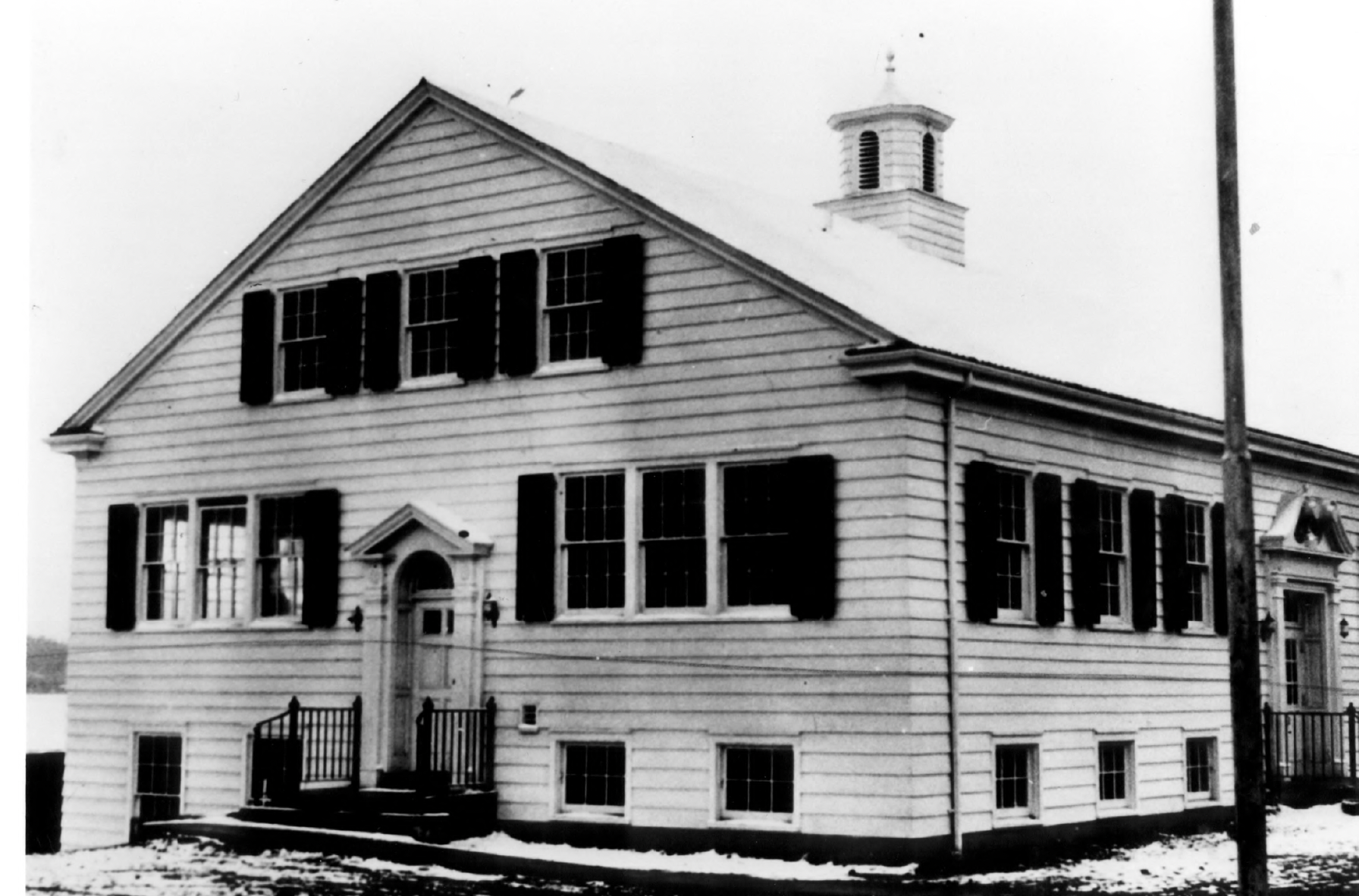
 The Mayflower School aka the Douglas Island Community Center is a two-and-one-half story, wood frame structure is at the corner of St. Anns and Savikko Road on the northwest corner. The building sits on a banked slope overlooking Gastineau channel, and Juneau can be seen to the northwest.
The U.S. Bureau of Indian Affairs built Mayflower School in 1933-1934 to serve as a model for Native schools in Alaska. The Bureau wanted the school to provide vocational education for Native children and to serve as a community center for the Douglas Tllngits.
The Daily Alaska Empire (10/13/35) informed its readers that the operation of Mayflower School was a "radical departure from the old."
The handsome building represents a significant tie with the past for many in the Douglas Native community and is the only Native school building in the Juneau-Douglas area still standing. It is the only Colonial Revival Bureau of Indian Affairs school in Alaska.
Education of Alaska Natives began when the Russian-Amerlcan Company and Russian Orthodox Church opened schools in Alaska at their major posts to provide education and vocational training for Creole and Native children. After the transfer of Alaska to the United States in 1867, the church continued to support several schools around Alaska.
The U S Government did not undertake responsibility for educating all Alaska Native children although it required the Alaska Commercial Company to operate schools for the Aleut children on the Pribilof Islands as a condition of the company’s 20-year exclusive lease to hunt fur seals on the Islands. Shortly after the transfer, the residents of Sitka supported a public school for all children interested in attending, but it closed in 1870 when the city's economy declined.
The Presbyterian Home Mission Society was the first American missionary group to open schools in Alaska for the Native children. In 1877, their first school opened at Fort Wrangell, and by 1884 the Presbyterians had schools at Sitka, Haines, Hoonah, Fort Tongass and Howkan.
Finally, in 1885 Congress provided for the establishment and support of public schools in Alaska "for Native and non-native children and appropriated $25,000 for this purpose. After Alaska became a territory, the Territorial Legislature established a Department of Education in 1917. Most of the schools supported by the Territory were in the larger non-Native communities. Control of education for Alaska Natives was transferred from the Secretary of the Interior to the Bureau of Indian Affairs.
The community of Douglas started as a mining camp in 1881 and grew due to the success of the adjacent lode gold Treadwell Mines. Many Natives moved to Douglas and worked at the mines.
The Friends Society of Kansas sent Elwood W. Weisner and Francis W. Baugham to Douglas to establish a school and home for Natives in the summer of 1887. The home accommodated 14 boarding students and the same number of day students. Because it was the only school on Douglas Island, it was attended by both Native and non-Natlve children. It operated until 1902, when the missionaries moved to Kake, another Southeast Alaska community.
The federal government built a school in Douglas for Native children in 1890 at a cost of $900. In 1902, a second school was constructed on the beach near the Native village that served until it burned in 1926. In their annual reports to the Bureau of Education, teachers repeatedly complained about the poor condition of the school.
The fire of October 11, 1926 burned the entire Douglas Indian village that included 42 homes, the school, stores and churches, as well as a number of homes outside of the Native village. After the fire, the teacher, Rose Davis, requested permission to rent quarters for herself and the school.
From 1926 to 1934 Native children in Douglas attended school in a variety of locations. One informant recalls classes being held in the upstairs of an old theater. In 1933-1934 the U.S. Bureau of Indian Affairs constructed a number of school buildings throughout Alaska from a Public Works Administration grant of $175,000 supplement ed by $30,000 in Territorial funds. By September 1934, new schools stood at Teller, Buckland, Little Diomede Island, Hydaburg, and Douglas. The Douglas School cost $9,500.
The name Douglas Indian Community Center was replaced with Mayflower School. This name was derived from Mayflower Island, a tiny island located in Gastlneau Channel off Douglas Island. The school built by local citizens under the direction of the Southwestern District of the Bureau of Indian Affairs, Alaska region, was a handsome white-bodied, green-shuttered, Colonial Revival building. Mayflower School operated as a school for Douglas Native children only for six years.
In 1940, it merged with the Juneau Government School. Native children from Douglas and Juneau were divided by grades between the two schools. In 1948, the school system for Native children merged with the local public school system. The Bureau of Indian Affairs turned over the school to the City of Douglas to be used for school purposes. Douglas and Juneau public schools consolidated in 1955, Juneau and Douglas city governments consolidated in 1970, and Mayflower School was added to the real estate holdings of the new political incorporation.
Rose Davis taught Native children in Douglas for 20 years, and was the principal teacher at Mayflower School from 1934 to 1942. The Dally Alaska Empire reported on June 2, 1934 that starting July 1st Mrs. Davis would advance to all-year service because the Bureau of Indian Affairs envisioned Mayflower School as a "real community center in connection with the wonderful facilities of the new school building."
The newspaper quoted Charles W. Hawkesworth, Chief of the Bureau, in its October 13, 1935 issue on the new approach to education that Mayflower School would pursue. It would have a more home like setting, and emphasize "a practical type of education." Children would learn vocational skills such as taxidermy, boat and furniture building, coffin making, weaving, and rug making. In the classroom, the children had tables and chairs suited to their size instead of benches and desks.
Mrs. Davis opened the library to the community in the evenings. The recreation room had a basketball hoop, and was also open after school hours. The Native community was encouraged to use the showers, laundry facilities, and kitchen in the school. The Alaska Native Brotherhood and Alaska Native Sisterhood regularly held meetings at the school, and the organizational meeting of the Douglas Indian Association took place in the recreation room.