
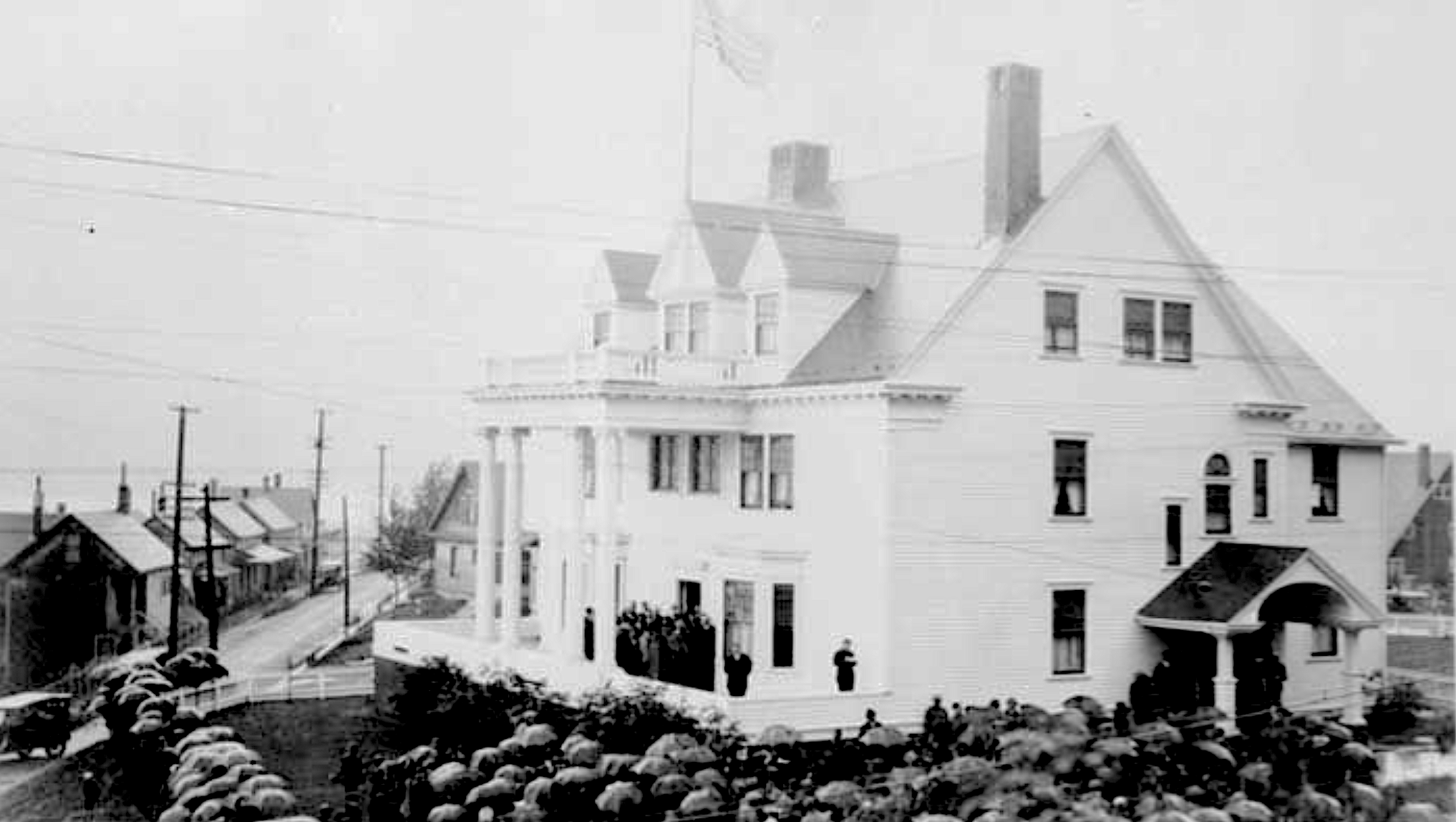
The Governor's Mansion was designed by James Knox Taylor. He was a Fellow of the American Institute of Architects, then serving as the first Supervisory Architect for the U.S. Treasury Department.
Taylor utilized design premises which had succeeded in Eighteenth Century English and American Colonial country houses.
These houses were designed to produce the most usable space for the cost, with facilities to perform the formal institutional functions required, and spaces amenable to formal and informal living under the same roof.
The examples he appeared to have followed had succeeded in performing these functions. The modifications he designed into this building succeeded admirably. An additional virtue of his design is that it permitted the basic building to be constructed and pressed into full service, with additional finishing construction, furnishing and decorating accomplished over a long period of time, as funds and authorization were provided.
An Act of June 6, 1900, provided that the temporary seat of government for the District of Alaska would be established in Juneau "when suitable grounds and buildings are available." From the passing of this 1900 Act by Congress until the Mansion was completed and occupied in 1913, a series of events—dramatic when considered as a totality moved forward the concept of more self-government for the Territory.
Continued Congressional attention to Alaska resulted in an Act for the Protection of Game, June 7, 1902; an Act Creating Road Districts and Providing for Road Overseers, April 27, 1904; the long-sought Delegate in Congress Act, May 8, 1906. The site of the building had been reserved in 1911 by Executive Order of the President, Number 1331. The Second Organic Act, August 24, 1912 provided that the capital of the Territory ". . .shall be at Juneau."
The Governor's Mansion, already under construction when the Act became law, thus became the first public building constructed for the new permanent capital of the Territory. The Alaska Governor's Mansion was first occupied by the Territorial Governor, Walter E. Clark, and his family, on January 1, 1913.
The Act also created a legislature of twenty-four members—two Senators and four Representatives from each of the four judicial division—to convene "at the capitol at the city of Juneau, Alaska on the first Monday in March in the year nineteen hundred thirteen, and on the first Monday in March every two years there after." The first legislature convened in space rented in the local Elks Club hall.
Juneau was a busy community. It had been founded as a mining camp, and had flourished as a result of the mines on both sides of Gastineau Channel and the marine commerce spawned by traffic between the lower states and the greater Alaska to the north and west.
A. H. Humpheries, an official of one of the mines recalls what Juneau was like in the era when the Governor's Mansion was under construction and the Territorial Government was about to begin full operation in the town, "Juneau in 1912 was alive and booming.
I had gone there from "The Westward" as we called it, out around Cordova and Valdez, after two memorable years in the Kennecott copper and Valdez trail country. ...men were shaved and groomed. Businessmen were in city clothes. A great treat to us was to see women and children on the streets and in the stores. ...the streets were thronged with pedestrians on the sidewalks. Horsedrawn vehicles threaded the centers.
I had spent five years in New York City. It never appeared to me so civilized as Juneau did that first day in 1910. The stores were busy, and displayed good merchandise.
Both the raised sidewalks and the streets in the main part of the city were of planking. They were very clean with streams from fire-hose nozzles. There was an efficient sewer system, ample electricity, and a telephone exchange with "hello girls" who would trace a party for you anywhere they could be reached. ...
The morning following our arrival, after breakfasting..., we sought out the source of the town's activity—the office of the Alaska Gastineau Mining Co., in the Valentine Building . . . and walked out with jobs. My friend was to work with Herman Tripp at Sum Dum Mine. ...Ed Russell published the "Dispatch." . . . "The Juneau Empire"... later, founded by John F. Strong and John W. Troy, . . .They had been associated in Nome with the "Nugget," and much later became governors of the Territory. ...
There was a staff-house with "private mess" down by Gold Creek at the foot of the tram and a big bunkhouse and a mess hall up the hill near the mine.... The mine was in the development and construction stages. Everybody in the organization was new and came from some other place.... ...the Alaska Gastineau mine was being developed for 6.000 tons of ore daily output.
The Alaska Juneau Mine, with an even more modern reduction plant, was planned for 10,000 tons a day, while across the channel the thirty-year-old Treadwell Mine properties were producing enough ore to keep some 2.000 stamps continuously pounding it to pulp 363 days a year. All this activity made the Juneau-Douglas operations for a short time at least, rank as the hard-rock miners' capital of the world....
I was thirty in 1913.... The very recollection of . . . that period fills me with pleasure. We can never recover the feeling we had toward each other in that distant simple age. The nearest I can think of to parallel it, would be a cruise ship that had been long enough at sea for everybody to get acquainted. We had a feeling of being of the world, but separated by time and distance. We were constantly refreshed by the arrival of new people from "below." ... at that period I had never met an adult Caucasian born in Alaska....
In 1912, the only automobile in town was Bart Thane's official Model T. It was chauffeur operated. The streets seemed full of horse-drawn vehicles, buggies, delivery wagons, big Studebaker ranch wagons, a lot of them designed so runners could be substituted for wheels when snow descended on the town. The freighters used "common sense" bob sleds in winter. There was no snow removal at that time. We just tromped it down and wore it out.
There was no radio, and no television in that distant age. But there was plenty of diversion in the big social hall for those off shift. We formed the Ptarmigan Club, and invited the whole town to a house warming dance when the place was opened for business....
It was almost the last stand in Alaska and in the West of the now forgotten art of driving workhorses. . . a string of five or six four-horse or six-horse teams, hitched to heavy Studebaker wagons, loaded high and safety-lashed, teamsters sitting on top or even standing precariously for a better view fore and aft with a handful of lines, would pull out of Willoughby Avenue at a fast walk along Front Street and then, with infinite care make the sharp turn up Seward—hoofs pounding, chains rattling, harness creaking, wheels rumbling, every axle speaking its piece—the leaders prancing proudly with necks arched under their reached manes. One team after another, that was the scene twice a day for several years. . . .
Jay Hayes, Alaska Road Commission superintendent . . . had to keep roads up without money.... By 1915 a few more autos appeared on the streets, plus a few delivery trucks. . . . Cash Cole bought a little red Model T. Doc Loussac, the druggist, had a black one shipped up....
Juneau was a busy seaport with big cargo and passenger ships docking nearly everyday and sometime three or four...."