
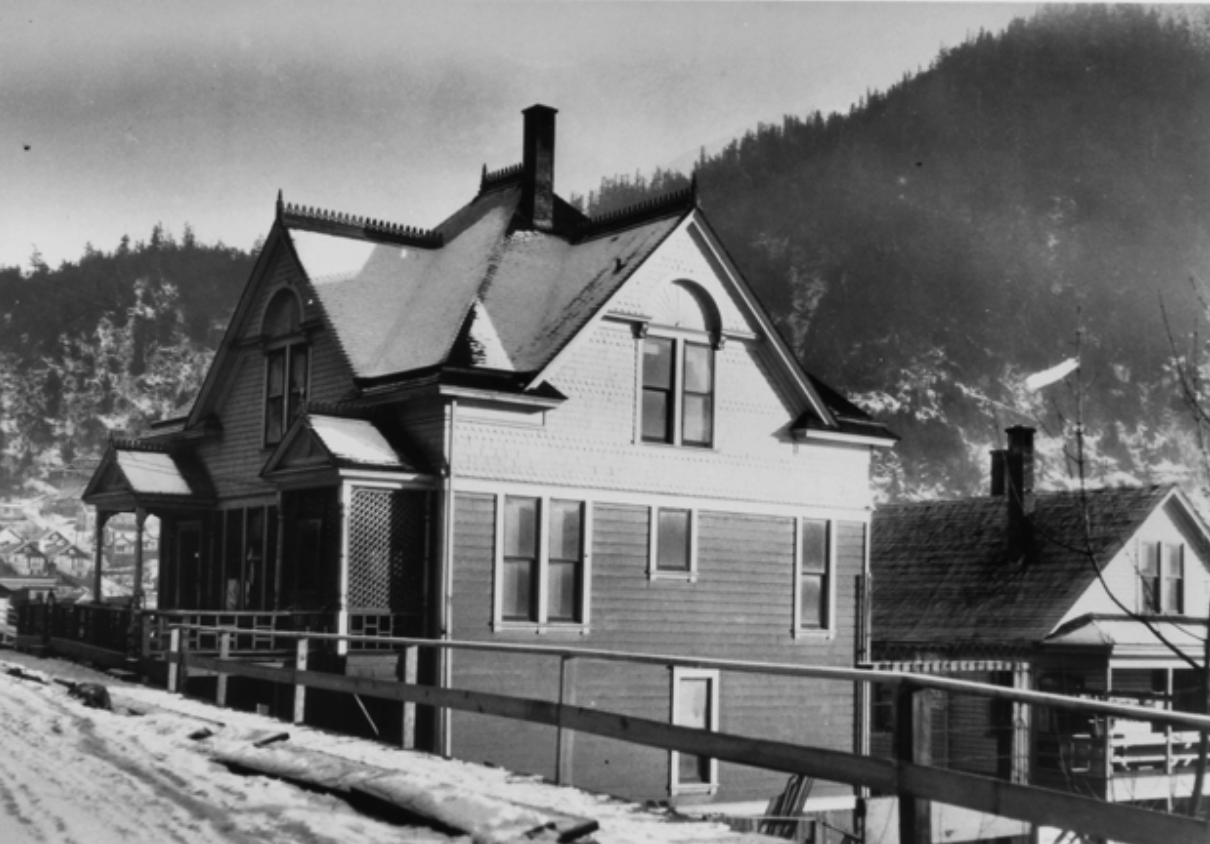
 Built in 1898, the Frances House, is significant for its architectural character, its place in the historic development of the mining town, and association with important historic people who built and lived in the structure during the early development of Juneau.
Eighteen years after the discovery of gold in Juneau, Jerry Eicherly, postmaster and owner of the post office, built the Frances House. During that time, the house was leased to a Superintendent of the Perseverance Mine.
In 1911, he sold it to John Rustgard, who owned it until 1927. Mr. Rustgard was the Attorney General of the Territory of Alaska from 1920 until 1933 as well as the author of a number of books on politics and economics.
When the builidng was condemned by the city in 1927 to make way for the building of Capital School, Frances Davis purchased it. Frances, one of the first recognized Alaskan painters, was married to John M. Davis, the assistant manager of the Nowell Gold Mining Co.
Her sons moved the house fifty feet to where it rests today. The building has been known to the Community as "The Frances" since that time. The house remained in the Davis family under the stewardship of Trevor Davis, pioneer photographer and a prominent person throughout the history of Juneau in the civic and business community.
It is an outstanding example of late nineteenth century domestic vernacular architecture found in Juneau. Essentially the house is architecturally typical in materials, construction and scale for the period it was built in Juneau. It is significant for these reasons, but more so because stylistically this house is unique. A roofline like that found on the Frances House is not found elsewhere in Juneau. The design is a blending of different architectural influences from the continental U. S. with improvised changes to make it appropriate for Juneau.
Detailing embodies unusually good design composition, and the quality of the craftsmanship is time-tested, in spite of minor changes in detailing that were made when the single family house was converted to boarding rooms in the early 1900's, when and the basement converted to an apartment in 1929.
The relationship of house to street is uniquely adapted to Juneau's topography and represents an interesting solution to a street regrading. The house is in a historic residential area where many of the "best" homes of early pioneers were located. It is a well known local landmark, appreciated for its reminder of Juneau's history. The structure retains character individually and as a significant example of Juneau's residential stock. The original fabric is intact and therefore its historic integrity as well.