
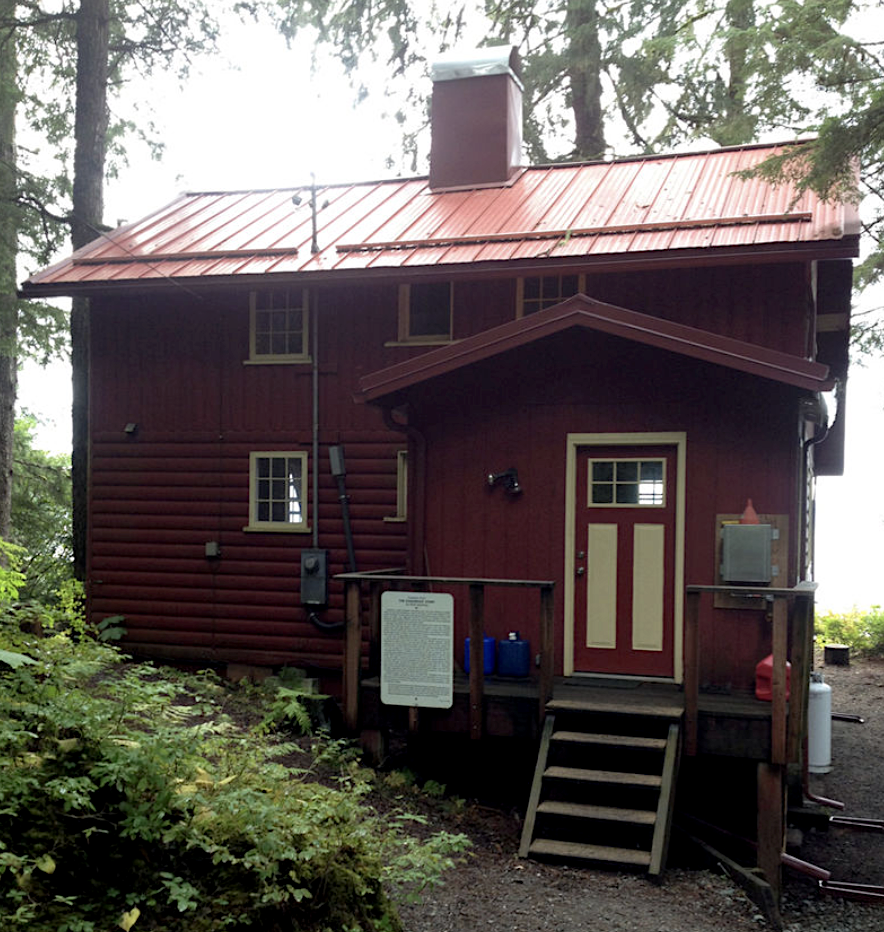
 Built during the summer of 1947, the Ernest Gruening Cabin is located at Mile 26 Glacier Highway, northwest of downtown Juneau. Gruening leased the 4.9 acre tract of land on which the cabin stands from the U.S. Forest Service in 1946, under provisions of the Small Tract Act of 1935, and later received title to it.
The cabin is oriented with a view to the west and overlooks Favorite Channel of Lynn Canal in southeast Alaska. The northeastern edge of the property is bordered by Salt Lake, where a low waterfall empties into Eagle Harbor. The southern boundary adjoins Amalga Harbor Road.
In 1947, Ernest Gruening, Territorial Governor of Alaska from 1939 to 1953, had a one-and-one-half story cabin built at a site twenty-six miles north of downtown Juneau. Malcolm MacKay was the architect, Fred Jacobsen and Hunt Gruening built it. The cabin is the only building in Alaska, other than the Governor's Mansion, directly associated with Gruening.
During his years in Alaska, Gruening fought for statehood, for a strong military presence in Alaska, and for more equal treatment of all Alaskans. In the spring of 1953 when President Eisenhower appointed a new territorial governor, Dorothy and Ernest Gruening moved from the Governor's Mansion to the cabin.
The cabin served as Gruening's principal residence from 1953 until November 1958 when Alaskans elected him one of their first U.S. Senators and he moved to Washington, D.C.
In his 1974 eulogy of Ernest Gruening, Carey McWilliams observed, "The persona never engulfed the self with Ernest Gruening. The public citizen and the private person were one and the same . . . and few Americans of his generation had a richer or more varied experience in public affairs. He was a man of impeccable honor and integrity, indomitable spirit and extraordinary moral courage . . . and, more than any one person, was responsible for the successful drive to acquire statehood . . . for Alaska." (The Nation. Julv 20, 1974, pp. 36-37).
Ernest Gruening was born in 1887 in New York City. He received his medical degree from Harvard Medical School in 1912, but never practiced medicine. Instead, he pursued a career in journalism, and was managing editor of The New York Tribune newspaper and The Nation.
In 1934, President Franklin Roosevelt appointed Gruening to be the first director of the Division of Territories and Island Possessions in the Department of the Interior.
Gruening served in this position until his appointment as governor of the Territory of Alaska in 1939.
Gruening first visited Alaska in May 1936, to deliver the commencement address at the University of Alaska in Fairbanks. On his tour through southeast, southcentral, and interior Alaska, Gruening noted the lack of adequate health facilities, inadequate harbors and housing, separate school systems for white and native children, and the high shipping costs between Seattle and Alaska. His interest in helping the territory get the many necessary and basic services it lacked led to his appointment as territorial governor.
As governor, Gruening pushed statehood for Alaska. He addressed the concerns expressed by members of Congress and the Department of the Interior; spearheading a personal income tax bill to show that Alaskans were willing to pay for state government, encouraging the Territorial Legislature to create a statehood commission, and promoting economic development.
Recognizing the strategic importance of Alaska in the war against Japan— and the development and revenue military activity would bring to the territory, Gruening
campaigned exhaustively for construction of air bases in Alaska. He termed Alaska the "first line of defense" for America and organized the Alaska Territorial Guard. After World War II, Gruening fought for continued military involvement in Alaska.
He also worked to end discrimination against Alaska Natives, and to get funding to combat tuberculosis that was epidemic in Alaska.
In 1953, the new Republican president, Dwight D. Eisenhower replaced Gruening as territorial governor. Gruening moved from the Governor's Mansion and to his cabin. There he continued to advocate Alaska statehood and tirelessly wrote articles for national magazines and newspapers. His 606-page book. The State of Alaska, was published in 1954. The State of Alaska chronicles Alaska's history and advocates statehood for Alaska. One reviewer wrote that the book "presented a powerful argument for statehood, [and] was undoubtedly written with that purpose in view. The case it makes is all the more compelling because it is predicated not upon an
emotional plea by one whose emotions are so surely involved, but rather upon a relentless review of facts which expose with dramatic clarity the disheartening effect of Governmental neglect, confusion, and bureaucracy on the one hand and exploitation by powerful economic interests on the other" (Saturday Review. February 12, 1955, p. 17).
Alaska achieved statehood on January 3, 1959. It took the combined efforts of many Alaskans, but Gruening was one of the chief architects and a
seemingly tireless crusader.
While he was territorial governor and after, Gruening entertained many notable guests at the cabin, among them presidential aspirant Adlai Stevenson, New York Governor Thomas E. Dewey, novelist Edna Ferber, Supreme Court Justice William O. Douglas, and Senator John F. Kennedy.
Although away from the cabin quite a bit promoting statehood, the Gruenings lived there from 1953 until 1958, when Alaskans elected Gruening as one of the first
United States Senators from the new State of Alaska. After they moved to Washington, D.C., the couple visited the cabin whenever they were in the state. A
fter his death in 1974, Gruening's ashes were scattered on the mountain behind the cabin, now named Mount Gruening. The family owned the cabin until 1989 when the State of Alaska purchased the property for an historic park.