
Alaska Native Tlingit and Haida people reportedly occupied Southeast Alaska for hundreds of years prior to European contact.
The Haida lived primarily in the southwestern portion of Southeast Alaska, while the Tlingit resided in the rest of the region. The Auk, Taku and Sumdum tribes of Tlingit people lived in what is now the City and Borough of Juneau at the time George Vancouver's crew noticed smoke from a campfire at an Auke Bay village. This first recorded account of the Auks was in 1794.
In 1867, The United States bought Alaska from Russia for $7.2 million dollars. Gold was known to exist in Southeast Alaska as early as the 1860s located in a string of highly mineralized deposits along the coastline from Windham Bay to Berners Bay.
George Pilz, a Sitka miner, was convinced that gold existed in the Gastineau Channel area when Chief Kowee of the Auk people brought him ore from the mouth of what was to be called Gold Creek. He outfitted two prospectors, Richard T. Harris and Joseph Juneau, and sent them to investigate. Following the creek to its headwaters in Silverbow Basin, they staked a claim on October 4, 1880.
Harris and Juneau established a 160 acre townsite at the beach near the mouth of Gold Creek on October 18, 1880 and named it Harrisburg. In early 1881, a town meeting resulted in the name being changed to Rockwell in honor of the Naval Commander that was sent to the area to establish law and order. By the end of 1881, Joe Juneau lobbied the local miners, complaining nothing in the district had been named for him, and it was agreed to change the town's name to Juneau. In 1900, Juneau was incorporated and named the seat of government for the Alaska Territory.
As early placer mining operations gave way to large underground mines, transportation of vast amounts of goods, materials, and people became increasingly important. The glacial, mountainous, and coastal terrain surrounding the Juneau area made overland transportation impossible. The only reasonable options were by sea and later air.
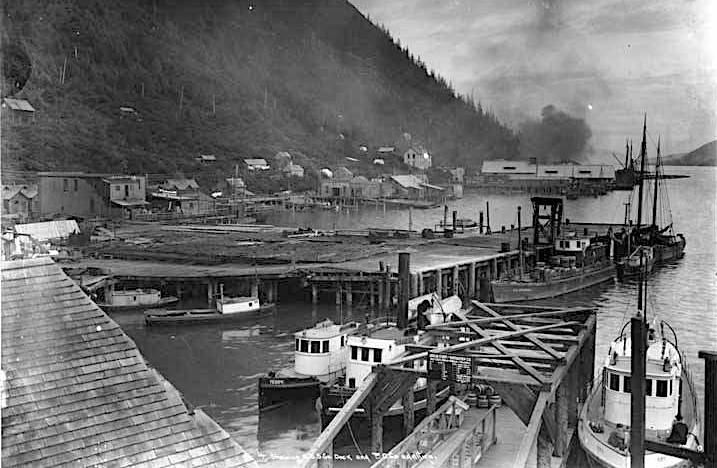
Juneau's harbor developed with a number of ship docks to handle the influx of commerce to support the growing community. By1901, the Pacific Coastal Steamship Company had a wharf and warehouse facility at the subject site. The facility served the shipping needs of the community until 1924, when Pacific Coastal was purchased by Admiral Line, a competing shipping company, and moved to another location on Juneau's waterfront.
The Juneau Motor Company purchased the property in 1924, and erected a garage and office on the wharf to serve their new business. This was Juneau's first Ford dealership as automobiles became popular.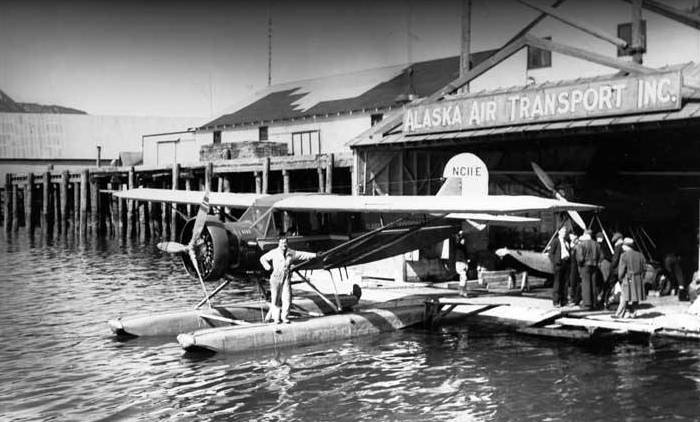
Aviation history was made on April 15, 1929, when Enscel Eckmann flew into Juneau in his Lockheed Vega named "Juneau." It was the first non-stop flight from Seattle to Alaska. Shortly after arriving, Eckmann formed Alaska-Washington Airways, Juneau's first airline. Alaska-Washington Airways operated out of a hangar built atop a large log raft anchored in front of the Juneau Motor Company facility. During the 1930s there were a number of companies providing float plane service out of the Juneau Harbor. These included Alaska Southern Airways, Pacific Alaska Airways, Panhandle Air Transport,Alaska Air Transport, and Marine Airways.
In 1936, the Juneau Motor company's building and dock were demolished by Alaska Air Transport (AAT) to make way for a hangar and repair shop. Local investors funded the hangar which was built to house five planes. The 5,000 square foot hangar was used in conjunction with a floating hangar already owned by AAT. A wood and steel ramp connected the new hangar to the sea level floating dock allowing loading/unloading of passengers and cargo.
In addition, a lift system, composed of a long boom, slings, pulleys and railroad tracks,was developed to lift planes out of the water and transport them into the hangar on the wharf. The 'crane' was designed by Shell Simmons and used for the first time to lift AAT's Bellanca on August 27, 1936.
Fire destroyed the Alaska Air Transport hangar on June 10, 1938. The Daily Alaska Empire (currently Juneau Empire) reported the fire started from a welding torch that ignited the fabric of a Bellanca Skyrocket float plane. Damage from the fire was estimated at $25,000 and included destruction of the Bellanca Skyrocket, substantial damage to the buildinq, and destruction of machinery, parts and tools. The buildinq was insured and plans were made to rebuild.
Sheldon "Shell" Simmons, owner of Alaska Air Transport, was quoted as saying, "We're in the flying business, same as usual."
Between 1938 and 1939,a new Alaska Air Transport hangar was constructed. In July 1940, Alaska Air Transport and Marine Airways merged to become Alaska Coastal Airlines. After the merger the new company purchased the hangar from the private owner from whom they had been leasing. In 1946, the building underwent a major renovation including a hangar addition of approximately 10,000 square feet. In addition, office space was added in 1951, and a baggage handling area was constructed in 1957. In the 1950's, Alaska Coastal Airlines served 33 towns throughout Alaska, only four of which had airports. Alaska Coastal Airlines was recognized as a model of independency because they were at least 1,000miles away from any repair-shop or parts department, thus all servicing and repairs were done in house.
In the July1959 issue of Popular Mechanics the article, "Alaska's Flying Bus Line", praised Alaska Coastal Airlines as being, "...a most unique air operation that's a tribute to old-fashioned American ingenuity." Many innovations came out of the Alaska Coastal Airlines hangar over the years, in order to combat the harsh Alaska climate and lack of available parts as well as making planes more efficient. Alaska Coastal Airlines retrofitted the first "Turbo Goose" by replacing the original engines with Pratt and Whittney PT6A turboprops.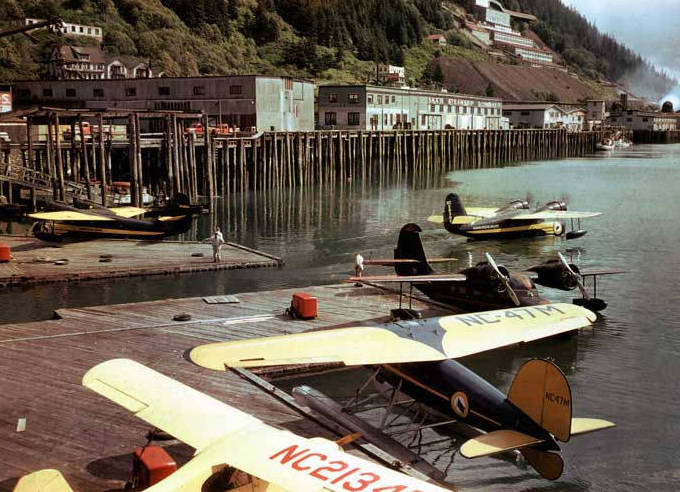
Coastal Ellis Airlines continued their operations out of the Alaska Coastal hangar. They owned and operated the greatest exclusively amphibian airline in the world, with the largest fleet of the legendary Grumman Goose in private hands. Today five of Alaska Coastal Ellis Airline planes sit in museums around the world. These museums include the McChord Air Force Museum in Washington, DC, the National Canadian Aviation Museum in Ottawa, the Tongass Historical Museum in Ketchikan, the Yanks Air Museum in Greenfield,California, and the Swedish Air Force Museum in Linkoping.
In 1968, Alaska Airlines purchased Alaska Coastal Ellis Airlines. Alaska Airlines did not wish to continue float plane operations based out of the Alaska Coastal Airlines Hangar building, so Dean Williams and Bill Bernhardt formed Southeast Skyways in late 1968 to fill the void, renting the hangar facility from Alaska Airlines. Southeast Skyways was strictly charter until 1969, when Alaska Airlines asked Southeast Skyways to take over the former Alaska Coastal Ellis Airline routes.
In 1974, Henry Camarot, Louis Dischner, and Frank Irich purchased the Alaska Coastal Airlines Hangar. The building was remodeled for use as a retail center with restaurants, shops, and offices. They named the bulldinq "Merchant's Wharf" which continues to serve as a retail center today.
About this time Southeast Skyways was purchased by Wings of Alaska. Although the hangar and repair facilities have been converted to retail uses, Wings of Alaska continues to operate from a floating dock to serve the tourist trade. These floats and associated aircraft activity are reminiscent of former operations at this location and serve as a reminder of the history and historic events of this aspect of Juneau's past.
Alaska Coastal Airlines Hangar Historic Survey, September 2006