
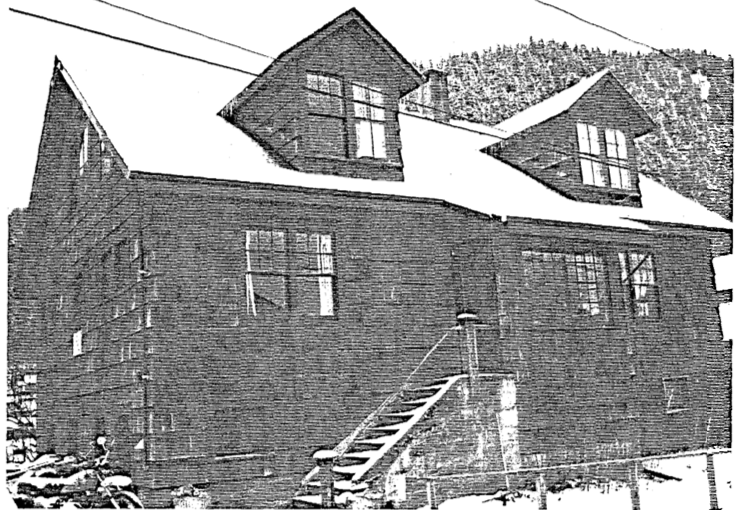
 The Edward Bayless House is located at 211 Dixon Street in the Telephone Hill Historic Neighborhood.
Ownership documentation of Lots 1 and 2 reveals that George Pilz and his wife sold the property to Juneau co-founder Richard T. Harris in March 1881.
Pilz grubstaked Joe Juneau and Richard Harris during their search for southeast Alaska gold. When Juneau's two founders discovered gold and reported to Pilz, he joined the others in staking local claims.
Although 1901 tax records show "lots and a building" and site improvements valued at $1,000, the Edward Bayless House located at on Lot 2 at 211 Dixon Street is reportedly visible in an 1885 photograph.
In a October 13, 1904 letter Richard wrote his brother that their father, "wants to sell the back lot so he can put up a new house and have money in case anything should happen to him." The boys own the place and he asks his brother to send permission for their father to sell the land. The permission was given but Harris did not sell the property as it will increase in value because the town is growing fast as was revealed in a November 20, 1904 letter.
The Harris family lived in a house on an adjacent lot at 219 Second Street, although Kitty Harris died in 1893 and Richard Harris died in 1907. William John Harris, Junior inherited the property on his father's death.
The original residence was replaced around 1910; the second structure stood until the late 1950s. Harris married Kitty, a Tlingit from Hoonah, in the 1880s. They raised four children in the Telephone Hill home. William Harris, the oldest surviving child, inherited the house after his father's death in 1907 (Walle, 1981). William was nationally published political cartoonist who was involved in early Alaska Native Rights efforts.
Harris maintained property ownership until 1912, when Claire Bayless and Edward Bayless purchased Lot 1 and built the Edward Bayless House. In 1913, tax records indicate a building was situated on the Bayless lot, and a 1916 entry lists a law library on the premises valued at $175.
Bayless, a registered Republican, engaged in a law partnership with Louis P. Shackleford. The Baylesses retained property ownership until 1921, selling to Thomas J. McCaul, owner of a cigar store on Front Street. McCaul continued ownership until 1933.
In 1941, Senna Paul Powers bought Lots 1 and 2 and the house.
The Bayless House, a rectangular, 30'x44.5', 1½-story Craftsman Shingle structure, has retained its architectural integrity. The post-and-beam frame is covered with cedar shakes and rests on a poured concrete foundation. The gabled roof is composition shingle-covered, and a chimney sits on the ridgeline. Extended eaves with fascia boards are visible.
The west facade features two gabled dormers. The original, double-hung sash windows with upper multi-lites are symmetrically arranged on all facades. Some original, wood storm windows are evident.
A small entry vestibule, oriented west, is centrally located on the main facade. Vintage doors appear here and at the basement entrance on the north facade. Small, multi-lite windows are located on the front entry, and smaller units appear on the basement level. The main floor is divided into two apartments; the upper floor contains one unit.
Telephone Hill Historic Site and Structures Survey, 1984, found that this well-built, unpretentious residence is important architecturally. A fine example of the Craftsman-Shingle style popular on the West Coast during the early 20th century, it has retained its architectural integrity. This distinctive design is evident in the building's original craftsman-like use of local and natural materials.
The most striking characteristic of this natural style is the dark-stained shake shingles covering the entire residence. The prolific use of shingles makes decorative trimming unnecessary. Other stylistic features include a moderately pitched, rectangular roof with gabled dormers. The eave overhangs were kept short for maximum display of the shingled walls. The original double-hung sash windows are grouped in twos and threes.
The house has undergone minimal structural alterations. It was found to be a contributing member of the Telephone Hill Historic Neighborhood.