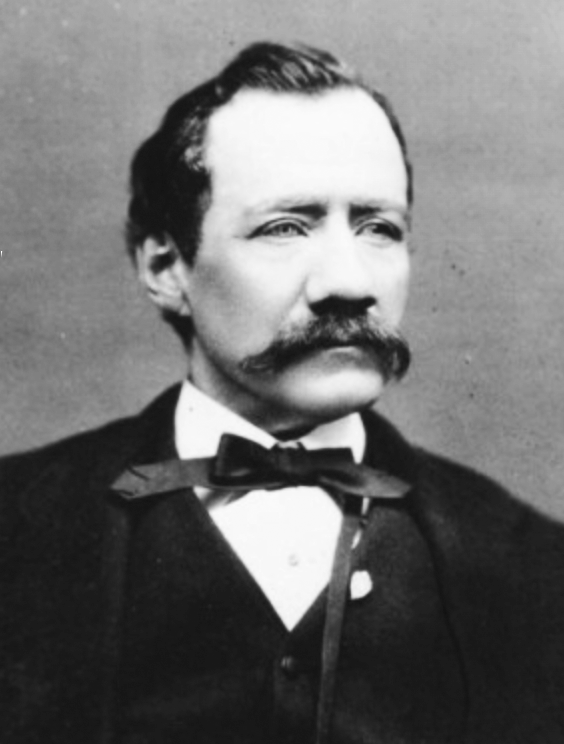
Harris, Richard

Richard "Dick" Tighe Harris was born in or near Drummadonald, County Down, Ireland, on October 31, 1837, to John Harris and Mary Anderson Harris. He was the youngest child of the second marriage of John Harris, and at least three of his siblings came to the United States in the great Irish immigration of the 1840s and 50s.

Dick was in America by 1855, and was naturalized by about 1858. Some of the Harris and Anderson families were already in the United States, making the transition easier for Harris than for some immigrants.

Harris lived in Pennsylvania and Ohio, where he stayed with his uncle Caldwell Anderson who was the brother of his mother, Mary Anderson Harris. He attended Duff’s Merchant’s College in Pittsburgh and graduated from that school in 1818.

From 1858 to 1868, Harris corresponded with a woman named Ellen McCutcheon. She also was an Irish immigrant, and both were interested in marriage. It is apparent that she was much more religious than he and that their social views were different. They did discuss marriage but her family was against that union.

In 1858, Dick went West, and probably stayed with his brother in Missouri after which he went to Kansas Territory.

In 1859, he apparently left Fort Leavenworth for the mining country. This was the beginning of his life on the mining frontier of America.

Harris both placer and lode mined while making his way though Idaho and Colorado Territory, the Virginia City, Silver Bow, and Butte before recording several claims near Bannack City, Montana Territory, where he probably stayed through 1868.

In the mid-1860’s, he was about to return to Pennsylvania to marry Ellen McCutcheon; but he never did.

There are no records in the collection concerning his activities between 1868 and 1877 but it is probable that he was engaged in mining and prospecting activities in various parts of the west during the period.

In 1877, Harris was in British Columbia. In the late winter and spring of 1879, Harris began to prospect and mine for George Pilz, an entrepreneur from Sitka. Harris had twenty years of frontier experience, and a better than average knowledge of mining law and procedures.

His Native American guide in southeastern Alaska was Chief Kowee. Kowee is credited with discovering much of the Juneau area. When they returned to Pilz empty-handed, he sent them back to the Juneau area.

In October of 1880, Harris, with partner Joe Juneau, made one of the most significant discoveries of American prospecting.

Kowee took them beyond Gold Creek to Silver Bow Basin, and within a two week period, they discovered and staked some of the richest placer mines in Silver Bow basin, but more importantly the lode system that ultimately became the Alaska-Juneau Gold Mine (AJ Mine).

The men shared discovery with the Takou claims, the basis of the Ebner. The Takou claims are above Last Chance Basin and would have been closer to the beach, hence probably more visible.

Harris named the town Harrisburgh after the capital of Pennsylvania; the Harris Mining District was however named after him.  In addition they located mill sites and a town site. Within two months, the stampede to the area began. The town's name was later called Pilzburg, then Rockwell. Juneau was able to buy votes from enough of his fellow miners for the name to be changed to honor him.

Richard Harris married Kitty, a Tlingit from Hoonah, around 1880. To their union four children were born. William J. Harris, Jr., was born on May 14, 1882; he died 2 days later. A second son was born to them on March 29, 1884, also named William J. Harris, Jr.  On November 10, 1885, Richard Tighe Harris, Jr. was born. Two-and-a half years later, on March 22, 1888, Mary Kelchine Harris was born.

A long time Mason, he was admitted to the Jamestown Lodge in Sitka in 1881.

Although his partner, Joe Juneau, sold out his interest in the claims, Harris, relatives, other whites and local Indians mined the Discovery Placer claim profitably from 1881 through 1885. Harris brought his nephew, William J. Harris, up to mine in 1882.

Harris called his own operation the Discovery Mining Company. Between 1881 and 1885, the company produced over $40,000 in gold and had expenses just over $14,000. During the off-season of these years, Harris visited relatives in the United States and shared his wealth with them and with the Harris family remaining in Ireland. Indeed his sister, Martha Jane Weir, later wrote that when her husband died, the only money that was left to her was that which Dick Harris had given them years ago. Other relatives also commented on his generosity.

In March 1881, Richard and Kitty purchased Lots 1 and 2 on Telephone Hill Historic Neighborhood from George Pilz and his wife.

Although 1901 tax records show "lots and a building" and site improvements valued at $1,000, the Edward Bayless House located at on Lot 2 at 211 Dixon Street is visible in an 1885 photograph.

The Harris family lived in a house on the adjacent lot 2 at 219 Second Street. The original residence was replaced around 1910; the second structure stood until the late 1950s.

After Kitty's early death in February 1893, at 26 years of age, much of Harris' concerns were centered around the education of his sons, who managed the difficult situation of being from two cultures much better than most. 

Supported by W. T. Coleman, Newman A. Fuller, former partner of George Pilz, sued Harris in 1884 because Harris worked an area of overlap between their claims in the Silver Bow Basin. 

During the proceedings, Harris was advised by J. B. Coglan, U. S. Navy, and represented by a man named Maloney. Pilz, who would have been his best supporter, was in jail in San Francisco, waiting for trial and unable to make bond.

Harris lost the case, lost all his mining interests, and because he was unable to pay a judgement, lost all of his properties except for several town lots. Later another lawyer, A. K. Delaney, informed him that his case had been “shockingly handled”.

In 1885, he served on the first Grand Jury in Alaska.

He began working for Thomas L. Nowell as the manager of the Alaska. Union Mining Company mill and property on Douglas Island in 1891; his salary was $100 a month.

Later, he worked for the District Court as Clerk and as Special Deputy Marshall and also for the U. S. Customs Service as an inspector.

In his later years, Harris became recognized as a pioneer and a founder of Juneau, Alaska. As such, he acquired a certain amount of prominence. In 1893, 1900 and 1902, articles appeared in Alaska newspapers discussing his contributions and his life. He continued to be interested in mining activities and he later grubstaked a few prospectors.

In 1900, he acquired a mining claim in the Porcupine District.

With the closure of the Nowell Mining Company in early 1901, Dick Harris was not only out of a job but in poor straits financially. He had to rely on the jobs with the courts and as the Coal Inspector for Customs Service to survive.

He attempted to sell the three family plots in Juneau in 1902 but, since they were in his children’s name, he had to obtain permission from them to sell. The sale, however, never took place and the land remained in the family’s hands.

In 1903, the Juneau City Assembly excused him from paying property taxes because of his services to the public.

In June 1904, he got the government deed for their home; a clear title to the property in boy's names with him as guardian.

Dick Harris’ eyesight began to fail by mid-1904. His son, Richard Harris, Jr., joined his father in Juneau in August 24th of that year. Richard worked his way up as a cabin boy on the steamer Faralone and had $4.00 when he arrived.

Richard bought his son a suit of clothes before taking him around town.  He wrote his son Williams that, "the old place is very pretty and a new cottage has been built on it."

A month later, the son wrote to his brother at Chemawa that their father had liver and eye trouble, and was needing new glasses. During this time he helped his father at the Customs Office.

In a October 13, 1904 letter Richard wrote his brother that their father, "wants to sell the back lot so he can put up a new house and have money in case anything should happen to him." The boys own the place and he asks his brother to send permission for their father to sell the land.

Before the year was out, Dick Harris’ eyesight was hurt by yellow jaundice, and his mind failed him.

He was sent to a nursing home operated by the Masonic Order in Portland, Oregon. Harris died there on October 11, 1907, at age 73. He was buried in Evergreen Cemetery, on December 28, 1907.

Harris Street still exists in Juneau, and the Pioneers of Alaska Juneau Igloo dedicated a memorial to Joe Juneau and Richard Harris.

Alaska Mining Hall of Fame

Alaska Consortium Library