

https://poajuneau.nationbuilder.com/garside_charleshttps://poajuneau.nationbuilder.com/degroff_edEuro-American presence in southeast Alaska began in·the latter part of the 18th century when explorers visited the area in search of highly prized furs, particularly the sea otter, for trade purposes. The survey for Alaskan resources included the search for precious minerals and the hope of discovering the famed Northwest Passage (State of Alaska 1982).
Countries involved in exploring the northwest coast of North America included Spain, England, Russia, France and Japan. Russian explorers are recorded as the first to encounter Native groups in southeastern Alaska. The first published account of exploration in Gastineau Channel was written by Captain George Vancouver, describing his journeys in 1793 and 1794. Seventy years later, the name Gastineau Channel was included on the 1867 Humphrey manuscript furnished to Western Telegraph Company (Werner 1925).
John Muir, a well-known naturalist, visited Lynn Canal in 1879. Upon his return to Sitka after interacting with Chilkat Tlingits, Muir noted that gold might be found in the area lying between Windham Bay and Sullivan Island in northern Lynn Canal.
Chief Kowee of the Auk Tlingit brought ore samples to George Pilz, a mining engineer residing in Sitka in 1880. These samples confirmed Muir's statements of potential gold reserves in southeast Alaska ( DeArmond 1967).
Encouraged by Kowee's visit, Pilz grubstaked two miners new to Sitka, Joe Juneau and Richard T. Harris. On 17 July 1880 the parties signed a service agreement stipulating the condition of the survey work. In addition to providing three months of supplies, three Auk guides and a canoe for transportation, the contract stated: "It is further agreed that if parties of second part are successful in finding claims as above named they shall at once convey their report together with sufficient samples and proof of same to party of the first at their earliest convenience" (DeArmond 1967:33).
Juneau and Harris' departure from Sitka on 19 July 1880 marked their first attempt to discover gold along Gastineau Channel. While the two reached the area which later became Juneau townsite, their description of services performed conflicted with Chief Kowee's verbal report. They remained in the region for six weeks and returned to Sitka empty-handed in early September 1880. A few days after their return, however, Chief Kowee again visited Pilz bearing ore samples from his territory, and gave his account of Juneau and Harris' infamous activities.
 A second search effort was funded, and the results were considerably more productive than the first. Harris's diary account of 1880 states: "We prospected around Silver Bow Basin until the 18th of October and had our Indians pack out to the beach on salt water about 100 pounds of gold quartz rock, the richest I have seen. We picked the best specimens that we could find. We packed it over the highest mountain, a distance of three miles to salt water about the 20th of October" (0eArmond 1967: 51).
Their discovery of gold led to the settling of Juneau, the first town founded in Alaska following the 1867 purchase from Russia. Harris wrote a Code of Laws and staked a 160 acre townside of October 18th of that same year. Word of the gold reserve at Silver Bow Basin brought hopeful miners to the settlement originally known as Harrisburgh.
Additional surveys revealed an outcrop of gold bearing quartz on Douglas Island across Gastineau Channel. The rush of miners to Juneau spurred the development of support services, lending shape and dimension to the new community.
The Log Cabin Church was built in 1881. The same year Ed DeGroff established the Northwest Trading Company, the first retail store in Harrisburgh. The U. S. Navy constructed a military post called Rockwell for the supervision of miners in the rapidly growing mining camp. A government reserve adjacent to Telephone Hill served as the Rockwell barracks site.
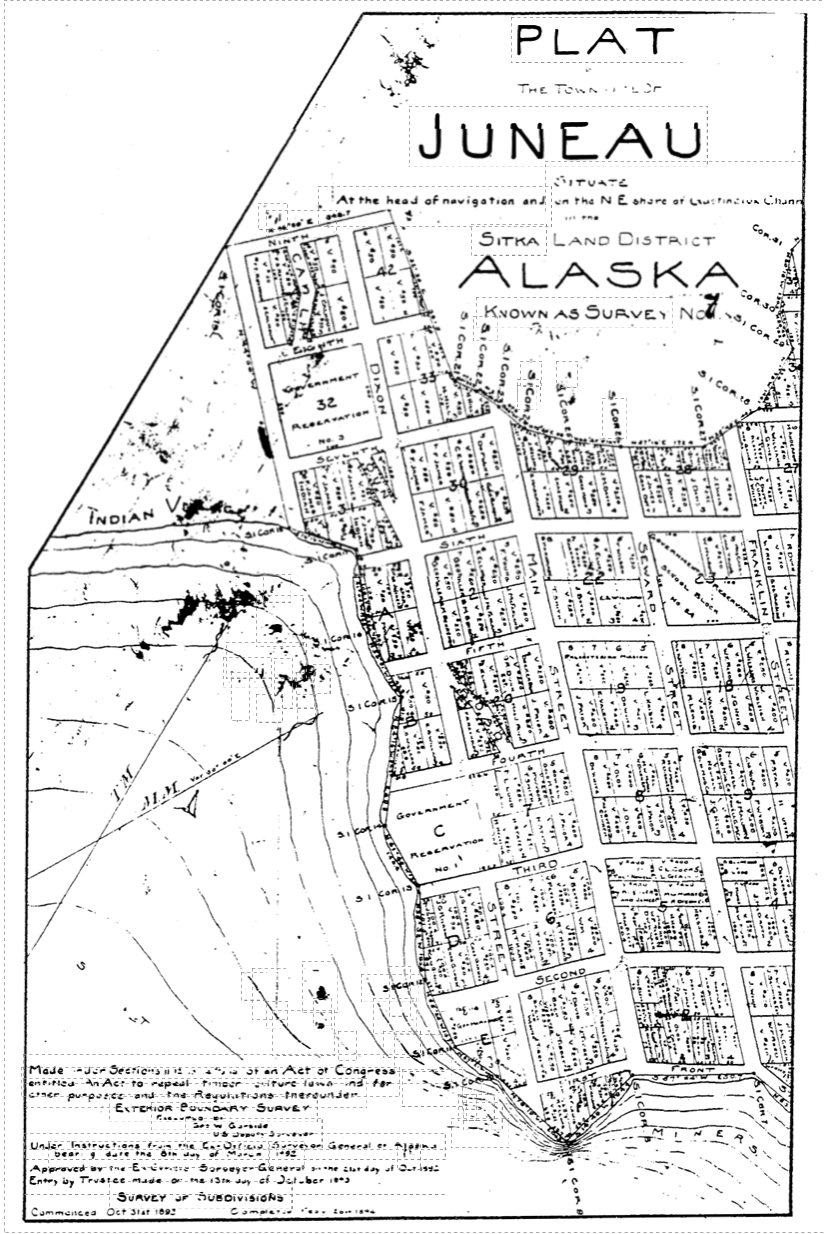
The first framed building erected in Juneau was a reassembled structure transported from Sitka in 1880 by George Pilz. Cabins built by miners were later modified or replaced by permanent residences. The Navy, in 1881, performed an initial survey of the townsite, and George Garside and Charles Garside later completed it in 1894.
Pioneers purchased lots in town, and homes associated with Telephone Hill property included: Richard Harris, Augustus Brown, John McKinnon, N. A. Fuller, George Pilz, John Sagemiller, John Olds, W. M. Bennett and Nathaniel Hilton (DeArmond 1967).
At one point, A. Goldstein claimed title ownership to the Juneau townsite. His claim, backed by the U. S. Department of the Interior, specified possible mineral deposits on Telephone Hill. Due to its unpopularity, however, Goldstein was subjected to lynching threats, and documents supporting his claim mysteriously disappeared. The claim was dropped after expensive, lengthy litigation.
In 1883, Juneau was considered a thriving settlement with a winter population of 1,000 people. The following year 50 houses were standing and 300 to 400 Euro-American inhabitants were counted. By 1890 the population reached 1,600. Specialty stores opened selling hardware, general merchandise, jewelry, baked goods and groceries.
Bach and Edward Webster started a telephone company in 1893, the beginning of a long-term, successful communications system (Werner 1925).
Mabel Cox, a missionary in the early years, recalls in 1898 Juneau was a town of 1,600 and 'looked as it had been thrown together at the foot of the mountain and continued up the side.' There were 40 saloons, gambling houses and houses of prostitution" (Anonymous 1973).
In 1900, Juneau became an incorporated town and the new capital site for the district government. By that time the town had undergone three name changes: Harrisburgh, Rockwell and Pilzburgh.
Miners voted in 1881 to permanently rename the town Juneau, in honor of Joe Juneau. The mining district was named for Richard Harris. Despite disagreements on the name, the town became the center of gold quartz mining in a 100-mile region along the coast from Windham Bay to Berner's Bay, its northern boundary.
The gradual expansion from mining camp to mining town continued for 60 years after Juneau and Harris' initial gold discovery. Sound business decisions utilizing the area's natural resources are credited with Juneau's stable growth. Gold prospectors consolidated adjoining properties and jointly developed hard rock mining. Continued consolidation of mineral mining and milling reduced production costs (Stone 1980).
The Treadwell Mine on Douglas Island was the first gold mining company to prosper around 1890. The site, originally discovered by French Pete Erussand, was successfully developed under the skilled leadership of John Treadwell, a miner from the California gold fields. By 1915 the 960-stamp mill crushed 5,000 tons of ore daily, a world production record at that time. Two years later the operation shut down overnight after the mine caved in (Stone 1980).
A second area of consolidated mining activities took place in Silver Bow Basin, site of Perseverance Mine and early pioneers' gold claims. Edward Webster, Richard Harris, George Harkrader, John McKinnon and George Pilz held claims in the basin. Perseverance Mine, established in 1885, grew until the quality of retrievable ore dropped to an unprofitable level in 1921 (Stone 1980).
The third area of mining development was the Alaska-Juneau or A-J Mine. The mine's ruins on the edge of town are a Juneau landmark. The A-J Mine, incorporated in 1897, continued operations for nearly 50 years, closing in the 1940s. Bart Thane, namesake to the settlement south of Juneau, managed the mine during its peak years.
The company's decline began in the 1930s and accelerated when World War II depleted Juneau's labor pool. The closing of the A-J marked the end of Juneau's mining era.
Juneau expanded its economic base to include fishing, timber, transportation, tourism and government support services, and the city grew despite mine closures.