

 The earliest documented Native American group to inhabit the Juneau area was the Auk Tlingits (Goldschmidt and Haas 1946). There was no permanent Native American habitation in the region until the establishment of the Juneau townsite.
Prior to Euro-American settlement, the main villages of the Auks were on Stephen's Passage at Auke Bay (Point Louisa), on the north end of Admiralty Island and on Douglas Island (Petroff 1880; Krause 1956).
On the mainland the Auks occupied the shoreline from Berner's Bay south to Thane on Gastineau Channel (Goldschmidt and Haas 1946). The local Taku Tlingits had settlements at the entrance of Taku Inlet, at the mouth of Taku River and on Douglas Island (Goldschmidt and Haas 1946).
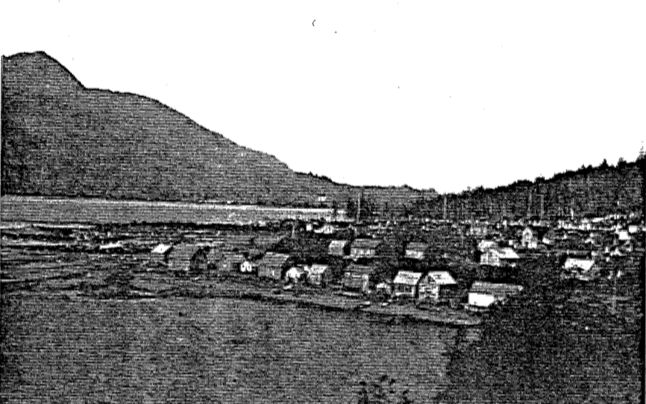
With the Euro-American discovery of gold in the Silver Bow Basin, Native groups established permanent settlements nearby. The Auks set up a winter village at their former seasonal camp north of town at the mouth of Gold Creek (Krause 1956; Rockwell 1881). The Takus settled on the beach south of town near the Alaska-Juneau (A-J) Mill.
The Auks were one of 14 distinct geographical Tlingit groups (Swanton 1908). The groups were further subdivided into autonomous social groups or village clans, and the earliest reference to the Tlingits was when the Russians arrived in southeast Alaska. Referred to as 11 Kolosh11 or 11 Koluschan11 (Petroff 1880), the Tlingit population during the early contact period was estimated at 10,000 (Mooney 1928).
The Russians observed an organized tribal system whose inhabitants lived in well-built log houses (Dall 1870; Olson 1967). The houses in their winter or permanent villages were generally in a single row, a few feet above the extreme high water mark, and often constructed on pilings.
They were situated along narrow beaches, usually at the base of steep hills that offered shelter, " ... generally upon level land ... through which streams of fresh snow water empty into the sea, and which in season are crowded with salmon, which constitute the principal portion of their food ... " (Beardslee 1882:174). The southeast Alaska waters also provided an abundant supply of herring, halibut and other fish.
The Tlingits' well-built canoes plied these waterways, connecting the far-flung villages of the Tlingit and Haida with a transportation network that stretched as far south as Puget Sound. The Tlingit established seasonal hunting and fishing camps away from their fixed, winter villages.
Known in Tlingit as "Tscantiq'chini ," Flounders or Gold Creek was a popular fish camp for the Auks prior to the arrival of the white miners. The stream had one of the largest salmon runs of any drainages along Gastineau Channel. Early miners observed two smokehouses and many gardens along the creek (Joseph 1967).
The Auks also established summer camps and smoke houses at the mouths of Salmon Creek, Sheep Creek and Fish Creek on Douglas Island (Joseph 1967). Hunting and berry gathering parties also used these camps.
The earliest historical reference to an Auk Tlingit settlement was made by members of Captain George Vancouver's 1794 expedition (Vancouver 1967). The crew observed a village near Point Louisa. Originally from the Stikine River area, the Auks reportedly had occupied Point Louisa since 1564 (Joseph 1967; Clark 1980). Their name, "Ak-won" or "Aukquwon,11 was derived from their discovery of Auke Bay; 11 auke11 means lake in Tlingit (Clark 1980).
The Auke and Taku people had been recognized as separate Tlingit tribes since the chronicles of the Russian priest Veniaminov. In 1835 he estimated a Tlingit population of 5,800 while the Auks numbered 100 (Petroff 1880). A definitive account of the various Tlingit subdivisions was not available until 1839. Douglas of the Hudson Bay Company broke the Tlingit groups down into local units. He noted the Auks "north of the Takoo River" with a population of 203. The Taku's numbered 493. (Petroff 1880)
The 1868 Report of the Commissioner of Indian Affairs (Document #102) noted that the Auks were scattered along Douglas Channel, on Douglas Island and on the mainland from Lynn Canal to Taku Inlet, numbering 700.
The following decade several United States military and civilian expeditions contacted the Auk peoples. In 1879 naturalist John Muir and missionary S. Hall Young made their historic exploration of southeast Alaska. During their travels they visited the Auks at Point Louisa.
Muir's theories of large gold deposits in the vicinity of present-day Juneau led to Harris and Juneau's historic exploration with Chief Kowee of the Auk Tribe. During the exploration, gold was discovered at Gold Creek and Silver Bow Basin.
Petroff's census of 1880 is the most authoritative account of the population breakdown of the main Auk villages. The Auks, numbering 640 out of a total Tlingit population of 6,763, had 290 people at Stephen's Passage, 300 people on Admiralty Island and 500 people on Douglas Island.
The first account of the Auks at their X'unaxi winter villages in Juneau came from Naval Commander C.H. Rockwell in 188 1. Rockwell's writings say the Native population on the town's shoreline were moved to village sites north and south of town to prevent potential conflicts with the miners. Lt. Frederick Schwatka, in his 1883 military reconnaissance of Alaska, observed the winter village at the mouth of Gold Creek, " ... a place of substantial and well-built homes" (1885: 75).
The Auks abandoned their Point Louisa village to obtain employment in the Juneau mines. During the same period, Krause observed 200 Natives at Juneau where they were "hired for rather a high wage, one to two dollars a day, by the whites as diggers, carriers and wood choppers" (Krause 1956:68-69).
By the turn of the century, there were 200 to 300 Natives in Juneau, with another 300 at Douglas-Treadwell, working in the mines and canneries (Alaska Monthly 1907). The Native groups worked in the mines until their closure in the 1930s and 1940s.
The 100 years following the establishment of the Juneau Indian village has been a period of profound social and economic change for the Auk and Taku Tlingit people. Nevertheless, Juneau Tlingits still reside in a portion of their original village site along Willoughby Avenue near Gold Creek.