

At 12:33 pm on July 15, 1920, five officers and three enlisted men were to take off on the first international cross-country flight in history. The four aircraft used were DeHavillandD H-4B's powered https://poajuneau.nationbuilder.com/henriques_edmund by 12-cylinder 400-horsepower Liberty engines.
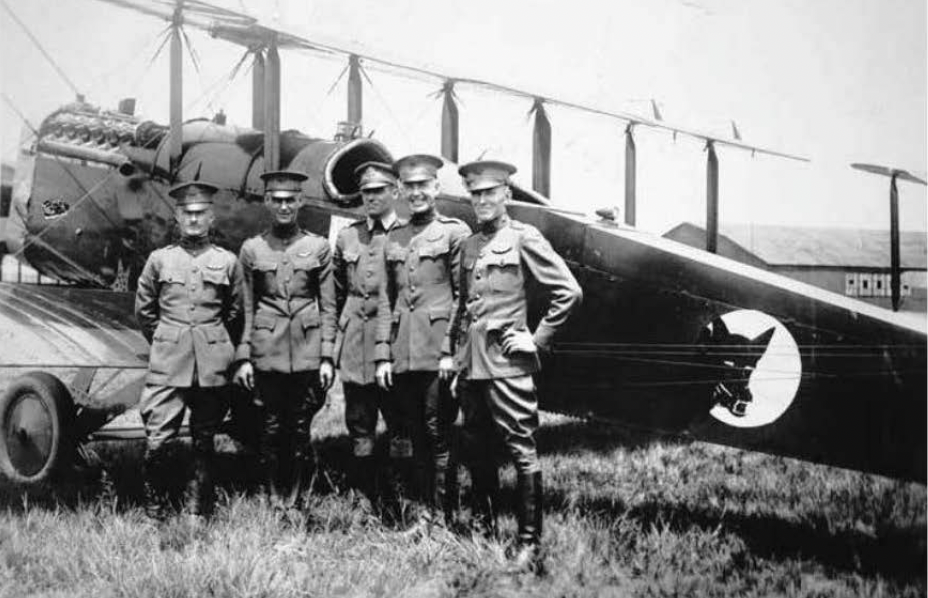
Members of the first Alaska air expedition standing by DeHavilland DH-48. The "Wolf Squadron" logo is clearly visible on the fuselage.
From left to right: Captain St. Clair Streett, First Lieutenant Clifford C. Nutt, Second Lieutenant R.C. Kirkpatrick, Second Lieutenant E.H. Nelson and Second Lieutenant C.E. Crumrine. July 20. Credit U.S. Air Force photo.
Several months had gone into planning of the trip, so parts were pre-positioned at various points along the proposed route and an advance ground officer had been sent ahead.
Captain St. Clair Streett, being the Squadron Leader piloted plane No. 1 along with Sergeant Edmund Henriques, his mechanic.
Plane No. 2 was piloted by Lieutenant Clifford C. Nutt with Lieutenant Erik H. Nelson serving as navigating officer for the expedition.
No. 3 was manned by Lieutenant C.E. Crumrine, who was also the aerial photographer and Sergeant James D. Long as mechanic. No. 4 was flown by Lieutenant Ross C. Kirkpatrick with Master Sergeant Joseph E. English as mechanic.
The flight from New York to Nome, Alaska was not a race, so the pilots were instructed to fly only when they thought it was safe to do so. Since fuel tanks only held 120 gallons and the planes cruised at 115 miles per hour, the distance would be covered in a series of short hops.
As well as flying over Lake Erie and Lake Michigan, other hazards would be encountered flying over tall mountain ranges and the lack of airfields enroute. At that time there were no airway beacons, no radios and no reliable weather reports or aerial maps.
At 12:33 all the planes were airborne. Stops would be made at Elmhurst and Erie, Pennsylvania; Grand Rapids, Michigan; Winona, Minnesota and Fargo North Dakota. Canada would be entered at Portal, North Dakota, then on to Saskatoon, Saskatchewan; Edmonton, Alberta; Prince George and Hazelton, British Columbia and on into Alaska at Wrangell. Then across again into Canada at Whitehorse, Yukon Territory, up to Dawson City, over to Fairbanks, Ruby and finally Nome. The same route would be followed on the return trip.
On August 14, after enjoying a barbeque at Prince George, the planes left, heading for Wrangell, Alaska with a brief stop at Hazelton, British Columbia.
They climbed to 10,000 feet, their maximum altitude, to fly over the many unmarked mountains which paralled the coastline. Jagged peaks seemed to claw at the frail machines and huge glaciers and sheer icy slopes loomed in a clear atmosphere.
The googles worn by the airmen were not tinted, so the glare caused by the sunlight reflecting off the snow nearly blinded the pilots and constant squinting severely cut down on their vision.
The squadron flew over a no-man's land, where not one piece of level land or even a small body of water made a suitable landing site. The pilots finally found themselves flying over the fjord-like bays which cut deeply into the coastline. Soon they sighted the town of Wrangell on the northern tip of Wrangell Island.
Prior to leaving Canada, arrangements had been made to land on the property of a Mr. Biern. This had been handled by the advance party. Birern had a farm there and this was the only area large enough to handle the planes, but the site was covered with three feet of standing oats!
After checking all possibilities, it was either land on Biern's property or turn back. Captain Streett called Mr. Biern and explained the situation to him and in typical Alaska fashion Biern offered to cut a runway through the oats and further stated he wold roll the runway until it became firm enough to give a smooth surface for landing. All the details were
left in his capable hands.
In the evening they were guests of honor at a public reception and dance. The banquet consisted of baked salmon. In wrinkled uniforms and muddy boots, totally unacceptable by Army standards, they shook hundreds of hands, twirled the local belles around the dance floor and from time to time, one would whisper to the other, "We're in Alaska! We made it to Alaska all in one piece!"
On August 16, the planes left Wrangell at 12:30 p.m. and headed for Whitehorse. Lieutenant Ross Kirkpatrick detoured and headed for Juneau. At 2:32 p.m. he was sighted from Thane by Mrs.W. T. Tolch, flying high, he then began his decent to 200 feet. A general fire alarm was sounded within three or four minutes after the plane was sighted.
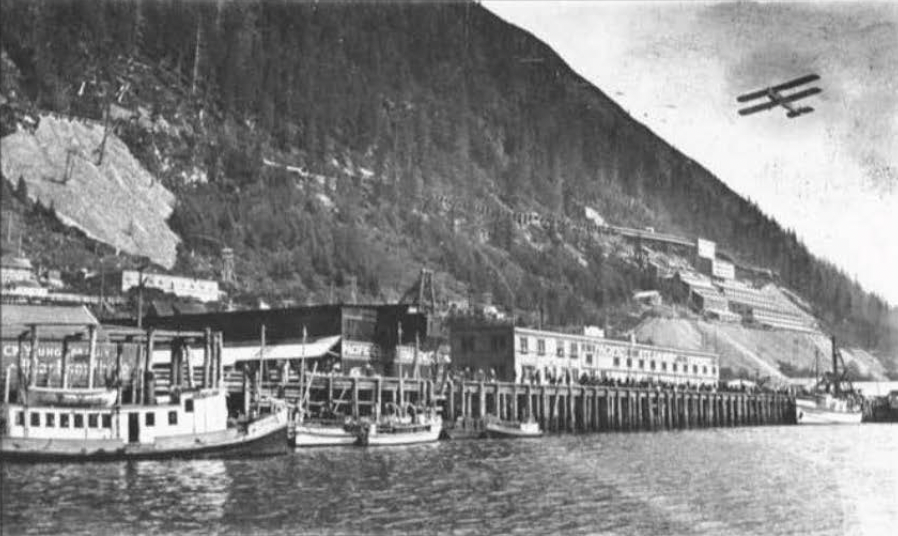
Winter and Pond photo of Lieutenant Ross Kirkpatrick flying over Juneau, August 16, 1920, Alaska State Library PCA 87-1089
Just over Front Street a gaily decorated package was dropped from the plane and landed on the roof of the Brunswick Hotel and was picked up by Dave Housel.
Mr. Housel handed it to Theodore Heyder, driving a Peerless Baker automobile. Mrs. Helen Roy of the Empire staff noticed it was addressed to Governor Thomas Riggs and conveyed it to Mrs. Riggs. It was a copy of the New York Times, and would be held until the return of the Governor to Juneau.
Despite the shortness of the notice, many persons had good vantage points along the Gastineau Channel to witness the first airplane flight up the channel. A good many people watched from atop the Goldstein Building. Later the other three aircraft flew high over Juneau enroute North.
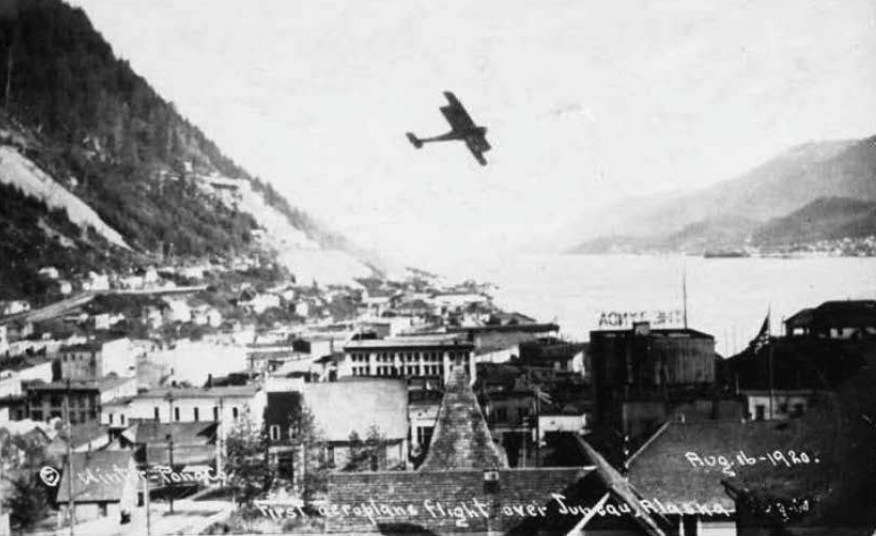 Lieutenant Kirkpatrick made history by flying over Juneau, the capital city on August 16, 1920.
Flying from Wrangell, he dropped a parcel for Governor Thomas Riggs and then proceeded to Whitehorse. Winter Pond phot, Alaska State Library PCA 117-41
Juneau had not been included in the flight plain, but at the request of Mayor R.E. Robertson, Captain Streett approved the flyover.
The flight continued on and they finally arrived safely at Nome. All members were made honorary members of the Pioneers of Alaska.
They covered 4,500 miles from New York to Nome without and serious trouble and it only took fifty-three hours and thirty minutes of actual flying time, over a period of 40 days.
All members of the flight were awarded the Distinguished Flying Cross for their feat. Captain St. Clair Streett retired from the U.S. Air Force in 1952, as a Major General. He passed through the heavenly portals in 1972.
As well as being the first airplanes in Southeast Alaska, they were also the first military aircraft in Alaska.
Jim Ruotsala, Pilots of the Panhandle, Aviation in Southeast Alaska "The Early Years" 1920-1935,
Seadrome Pr., 1996