
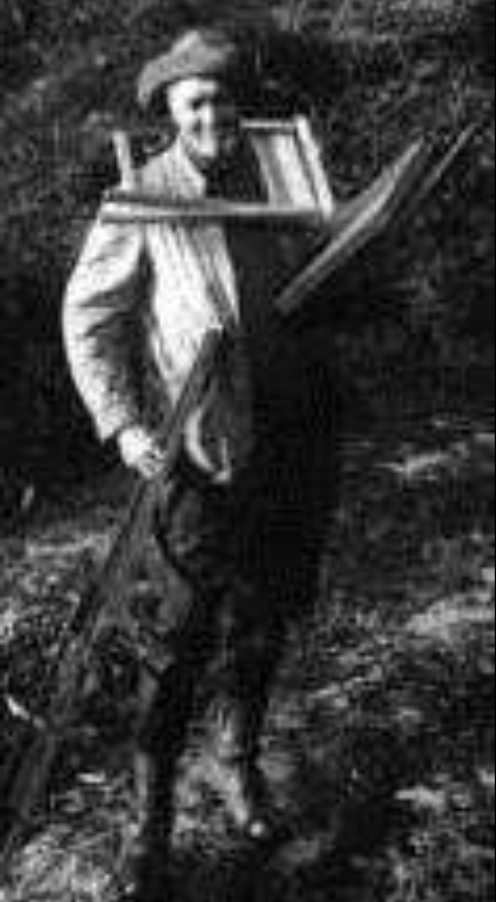
 Lloyd Valentine Winter was a charter member of the Juneau Men's Igloo.
Alaska history enthusiasts familiar with outstanding archival photography will recognize the studio name Winter & Pond.
During careers spanning more than fifty years, Lloyd V. Winter (1866–1945) and Edwin Percy Pond (1872–1943) compiled a vast catalog of photographs depicting the people and places of the North, particularly in Southeast Alaska and the Klondike.
San Francisco artist Lloyd Valentine Winter was the fourth of five children born to Englishman Robert Winter, an artist and “picture dealer,” and his wife, Josephine of Maryland.
The Winters encouraged their children’s talents in art, music, and trades. Their eldest daughter Emma became a music teacher; William worked as a plumber; Charles and Lloyd attended school; and the youngest child, Henry, was born when Josephine was in her forties and Robert in his fifties.
According to the 1880 federal census of San Francisco, when Lloyd was fourteen, the Winter family shared a home with Edward Gage, a forty-year-old man who worked in a photographic gallery. This exposure may have influenced Lloyd’s later career.
Winter arrived in Juneau in March 1890 and soon partnered with photographer George M. Landerkin. Together, they established the Landerkin & Winter Studio, a partnership that lasted until 1893, when Winter’s longtime friend, Percy Pond, arrived in Juneau.
In 1894, Pond purchased Landerkin’s interest, and the Winter & Pond Studio was formed. The business expanded beyond portrait photography to include Alaska curios, special-order photography, and commercial assignments.
Unlike many photographers of their time who worked only during the summer months, Winter and Pond remained in Alaska year-round. Their subjects included Tlingit families arriving for potlatches, miners pausing along the trail with their sleds, workers laying the Juneau-Skagway telegraph cable, and Chilkat dancers wearing ceremonial regalia.
The Winter & Pond photograph collection—now held at the Alaska State Library in Juneau—contains numerous early images of Juneau, the Klondike Gold Rush, local celebrations, and mining activity.
Winter’s ability to speak a Native language proved useful when the pair secretly observed a Haida dance ceremony in 1894. When they were discovered, the dancers warned them that it was a private ceremony meant only for Haida participants. Over time, the two photographers were adopted into the tribe, and each was given a Native name. Winter was called Kinda, meaning “winter,” while Pond was given the name Kitch-ka, meaning “Crow Man.”
The photographers’ work documenting Alaska Native communities before, during, and after the Klondike Gold Rush contributed significantly to Alaska Native cultural studies. Their long association with Tlingit communities allowed them to learn about traditional practices and cultural history.
Winter and Pond published several works on Alaska Native subjects. Anthropologist Edward L. Keithahn, author of the 1945 book Monuments in Cedar, acknowledged them as a source of information about the early Chilkat people.
Winter personally followed the Trail of ’98 into the Yukon during the winter of 1897–1898, producing stereographic images for Underwood & Underwood and providing readers of Leslie’s Weekly with photographs of Gold Rush activity. Winter & Pond were also named the official Alaska photographers for the Alaska-Yukon-Pacific Exposition held in Seattle in 1909.
Both men were active in the Juneau community. They volunteered with the Juneau Fire Department, Hose Company No. 1. In 1915, Winter served as Patron of the Order of the Eastern Star, Juneau Chapter No. 7.
Pond married a woman named Hattie, who appears in several photographs from the Winter & Pond collection, and the couple raised a family.
Between 1915 and 1925, the Winter & Pond Company also owned and operated mining claims near Juneau. Photographs documenting their mining activities are preserved in the Alaska State Library archives.
The partnership ended when Percy Pond died at age seventy-one on June 1, 1943. He was buried four days later in the Pioneer section of Evergreen Cemetery in Juneau.
Lloyd V. Winter died in November 1945 at age seventy-nine and was buried on November 13 in the Masonic section of the same cemetery.
Earlier that year, Winter had transferred ownership of the Winter & Pond Company to Francis Harrison, who continued operating the business until 1956.
Today, images from the Winter & Pond studio appear on the walls of the Alaska State Capitol building in Juneau and in public and private collections across the country. The Alaska State Library in Juneau holds the bulk of the Winter & Pond Collection—approximately 3,000 images dating from 1893 to 1943.
Source
University of Alaska Anchorage, Lite Site Alaska — article by Tricia Brown