
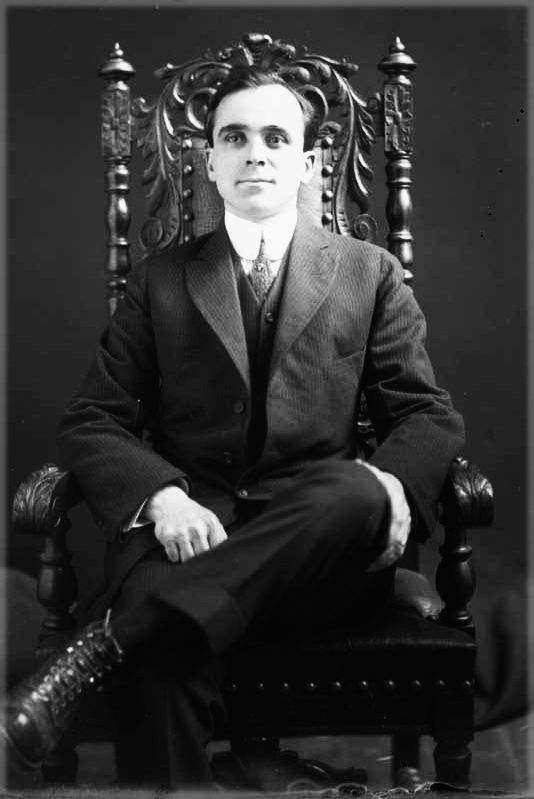
Primary Name: Thane, Bartlett L.
Filed as: Thane, Bartlett L.
Also known as: Bartlett Lee Thane; Bart Thane
Occupation / Association: Mining engineer; mine developer; Alaska Gastineau Mining Company executive
Associated places: Juneau, Alaska; Sumdum, Alaska; Sheep Creek, Alaska; Salmon Creek, Alaska; Annex Creek, Alaska; New York City, New York; Berkeley, California
Keywords: Bartlett L Thane, Bart Thane, Alaska Gastineau Mining Company, Perseverance Mine, Salmon Creek Dam, Sheep Creek Adit, Juneau Gold Belt, University of California Berkeley engineers, early Alaska mining engineers
Biography
Bartlett “Bart” Thane was a mining engineer whose work in the Juneau Gold Belt helped create one of the largest and most technologically advanced gold mining complexes in the world during the early twentieth century.
Thane was born in 1879 and graduated from the University of California at Berkeley in 1898. While attending Berkeley he was the star quarterback of the university’s football team. Many of his teammates studied mining engineering and would later assist Thane in his ambitious mining ventures in Alaska.
At just under twenty years of age, Thane came to Juneau to begin his mining career. He was hired by veteran mining man Herman Tripp to operate and maintain the shaft pumps at the Sumdum Chief Mine, located approximately sixty miles south of Juneau. Although initially skeptical of college-trained engineers, Tripp quickly developed respect for the young engineer, beginning a lifelong friendship. Within three years Thane had gained a controlling interest in the Sumdum Chief Mine.
By 1911 Thane had successfully raised investment capital and obtained operational control of six gold mines in the Juneau Gold Belt. A mountain in the region was later named for him.
Through a complicated series of events Thane gained control of the Perseverance Mine near Juneau. The company’s president, Colonel William Sutherland, had been accused by stock and bondholders of mismanagement and was facing legal action. Sutherland died suddenly of a heart attack, and competing claims by two wives further complicated the estate. The company appeared hopelessly tied up in litigation.
With financial backing from prominent mining financiers D. C. Jackling and W. P. Hammon, Thane raised eight million dollars in 1912 to take over and redevelop the Perseverance Mine. His project would eventually become the Alaska Gastineau Mining Company, which developed into the largest gold mining operation in the world at the time.
Thane’s plan for the mine had three major components: providing tidewater access through a two-mile tunnel, developing year-round hydroelectric power, and constructing a revolutionary mill capable of processing thousands of tons of ore each day.
The Sheep Creek Adit, begun in November 1912 and completed in February 1914, was 10,497 feet long and at the time was driven at the fastest rate of any tunnel excavation in the world. The tunnel provided access from the Perseverance Mine to tidewater through the Sheep Creek Valley.
With assistance from former Berkeley teammates, Thane also oversaw construction of the Salmon Creek Dam. Completed as the first thin-arch concrete dam ever built, the structure stood 172 feet high and 648 feet across at the crest. The design proved revolutionary, and more than one hundred similar dams were later constructed around the world using the same principles first demonstrated at Salmon Creek.
The massive mill constructed for the Alaska Gastineau operation was designed to process up to 6,000 tons of ore per day using new rotating mills developed in the large copper mines of Nevada and Arizona. Completed in 1915, the mill exceeded expectations and was soon processing approximately 10,000 tons of ore per day at costs lower than projected.
To meet the growing demand for power, Thane developed another hydroelectric project at Annex Creek on Taku Inlet. The site was optioned from Herman Tripp in April 1915, and power was being produced by December of that same year. The project marked the first time a lake had been tapped by tunneling beneath it and blasting through the lakebed to release water for hydroelectric generation.
When the blast opened the lake, water reached the turbines two miles away in just forty-two minutes. The Annex Creek and Salmon Creek hydroelectric plants continue to generate power today and remain among the lowest-cost sources of electricity in Alaska.
For a brief period before World War I, the Alaska Gastineau Perseverance operation was the largest gold mining complex in the world and produced more than 500,000 ounces of gold.
The loss of labor during World War I and rising costs following the war made the operation unprofitable. On June 3, 1921, the mine closed.
Thane later attempted to repurpose the facilities for a large pulp mill development. In 1923 an agreement was reportedly reached with Japanese investors, but the catastrophic Yokohama earthquake that year killed the investors and the proposed pulp project collapsed.
Although his work had transformed the mining industry and left lasting engineering achievements, Thane died in New York City in 1927 reportedly embittered by the collapse of his final venture.
Upon hearing of his death, Fred Bradley, the legendary engineer behind the Treadwell and Alaska Juneau mines, remarked, “He built great monuments to man, but forgot what he was here for.”
Sources
Juneau mining historical records