
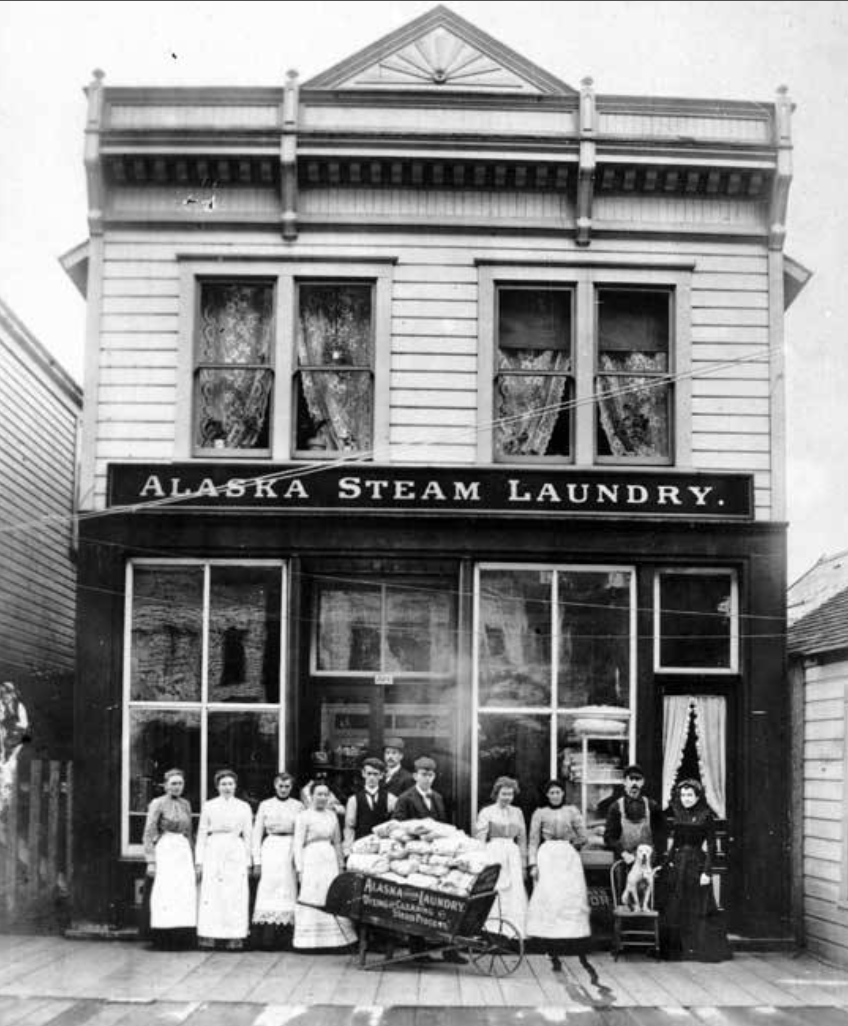
The Alaska Steam Laundry Company building at 174 South Franklin Street is an excellent architectural example of an important commercial enterprise which bridged the historical continuity of 19th and 20th Century Juneau.
When it became apparent after the 1880 placer gold strike that Juneau would not be a quick "boom and bust" camp —but rather would enjoy a long, prosperous future, with great mechanized mills, mines and a large payroll of miners, it grew more progressively than other mining camps and reached a level of sophistication surpassing any other in Alaska in the 19th Century.
This was assured by, first, the Treadwell mines, just across the narrow Gastineau Channel on Douglas Island. Deep mining started there in 1882, and by 1885, four corporate groups were mining with several stamp mills and a smelter were in operation.
In 1890 all operations at Douglas consolidated into the great Alaska Treadwell Gold Mining Company. It had then produced $14,000,000 from its four mines and 880 stamps in five mills. It would add some $40 million more to this by 1917 when wiped-out by an unexpected ocean cave-in.
On the Juneau side, starting the same pattern only a few years later, the Alaska-Juneau Gold Company, began acquiring all claims in that district, combined into one great mine and mill which operated up to 1948 and produced $67 million in gold.
Juneau was officially made the capitol of Alaska in 1900, with the executive offices gradually moved from Sitka by 1906. This brought about the residence here of most of the territorial and federal employees in Alaska, in seven territorial departments and 27 federal offices.
At Tacoma, Washington in 1894, Ernest Reinholt Jaeger and his wife, Anna Jaeger, flipped a coin to determine whether they should move to Hawaii or Alaska. The coin favored Alaska.
In January, 1895, Mr. Jaeger selected Juneau as the most promising business location in the Territory, and arrived by steamship from Seattle. Because of the extensive payroll of miners and millworkers—mostly single—laundry and cleaning was a lucrative enterprise.
He leased the Juneau Steam Laundry from A.H. Day, then located in log cabin on the hillside at the end of 2nd just beyond where the Baranof Hotel was later built.
Anna joined him in March, traveling on the maiden voyage of the new flagship of the leading Alaska line, Willapa. The Jaeger family, soon increased by the birth of a daughter. Hazel Jaeger, lived in an adjoining cabin and operated the laundry from there for several years. Then they moved to a larger existing building on Front Street.
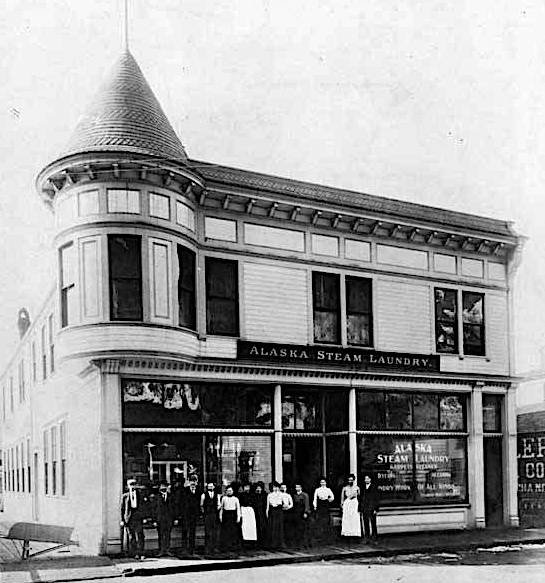
Having prospered, he decided to build a show-case operation which would have outlets in Apollo, Valdez, Sitka, Ketchikan and Wrangell; thus the name: Alaska Steam Laundry.
The Jaeger's resided in the master apartment upstairs while Hazel attended local schools. Then they built a home on Fourth Avenue.
While attending Juneau High School, Hazel was a classmate of James Simpson MacKinnon AKA Sim MacKinnon, son of a pioneer Fortymile and Juneau mining family.
Hazel attended Mills College in California and then returned to Thane, Alaska to teach.
Sim MacKinnon was appointed to the U.S. Naval Academy and graduated as an officer.
They were married in 1923 and spent several years in the Orient, where their son, J.S. Jr., was born, at Manila.
In 1926 Slim retired from the Navy and returned to Juneau to take over management of his Father-in-law’s laundry business.
No longer "Alaska Steam", nor at the same location, the business continued into the fourth generation with grandson Neil MacKinnon, who graduated from the University of Alaska at Fairbanks.
Alaska Steam Laundry is one of the better existing examples of the transition of Juneau from mining camp to Capital City.