
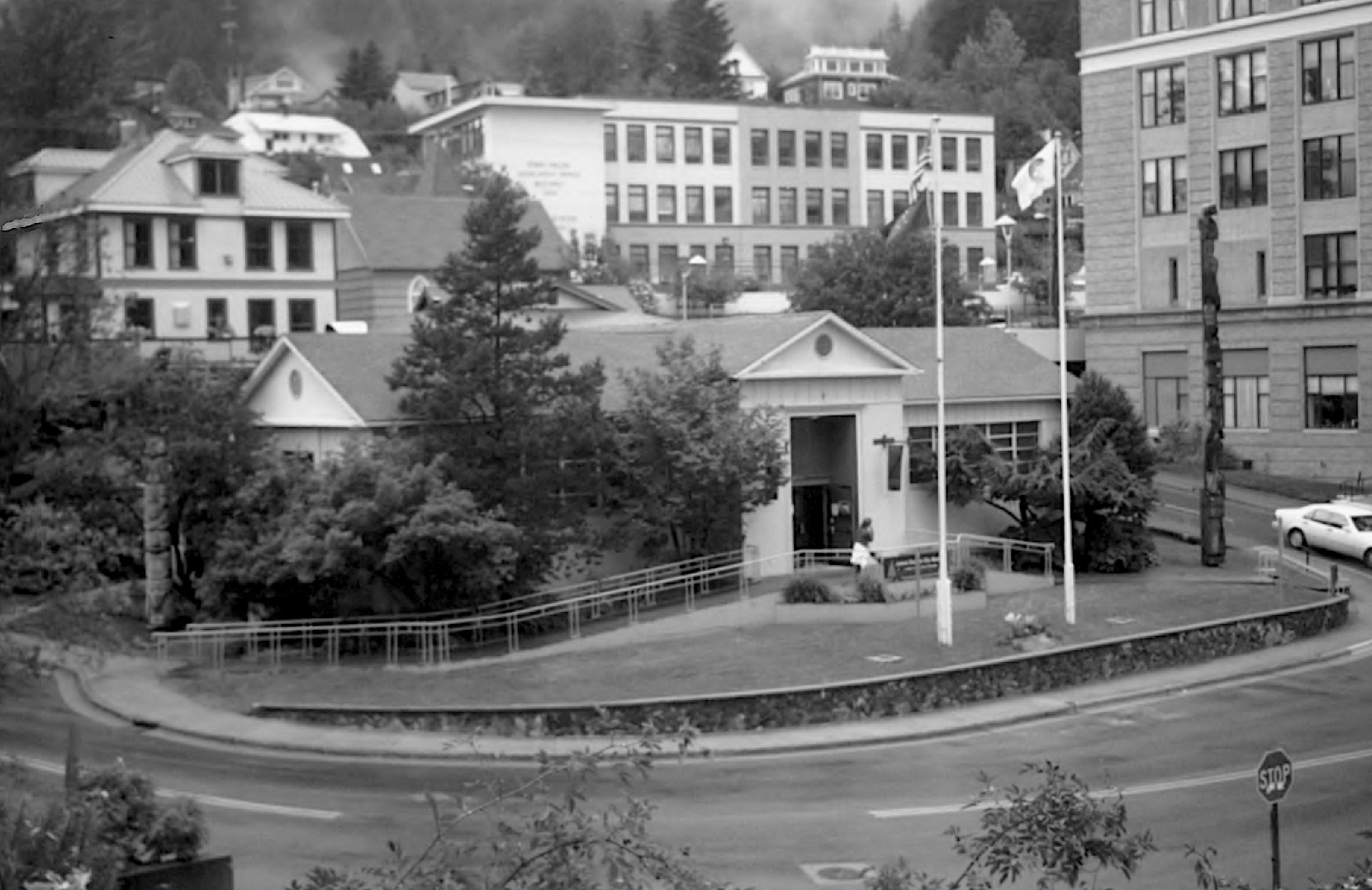
 The Juneau Memorial Library, aka the Veterans Memorial Building, located at 114 W. Fourth Street, has a commanding presence, sitting on a hillside at the corner of Fourth and Main streets, across from the Alaska State Capitol and overlooking downtown Juneau.
The building stands on a prominent location in the community, next to Alaska's state capitol, on a hill overlooking downtown Juneau with a residential area behind it.
The Juneau Memorial Library, completed in 1951, was the first major community project initiated by Juneau residents. The Juneau Rotary Club undertook construction of a library building for the town's residents as a memorial to the men and women of the area who fought in World Wars I and II.
A local architectural firm designed the stately reinforced concrete building incorporating Neo-Classical Revival architectural elements.
The building housed the community's library until the mid-1980s. It is now the city's museum, continuing to be a public facility serving the community. The period of significance starts in 1951 when the library opened and ends in 1959 to encompass the statehood event.
Following the discovery of gold on Gold Creek in Silver Bow Basin in 1880, the town of Juneau was established. It became a center for large scale hard-rock mining. The city incorporated in 1900 and became Alaska's capital in 1906. It was Alaska's largest community from 1920 to 1950.
In 1897, the Juneau Public Library Association, comprised mainly of local ministers, organized and provided a library collection that was housed in the federal courthouse. In 1898, the building burned and the library with it. A library was not reestablished.
In 1906, a party of American Library Association visitors met with Juneau's mayor and left a collection of books. The mayor told the group he would try to get the City Council to pass an ordinance to establish a free library. Apparently, the Carnegie Library Foundation Association made an offer of a building to the city after the visit.
Juneau did not have a public library again, however, until 1914 when the Juneau Draper Club, a civic group, founded one. The club bought books, rented a small building, and hired a librarian. They opened a reading room in August 1914 and a circulation department in December 1914.
A Juneau Library Association organized in April 1915, and at the end of the year reported 141 monthly subscribers and 55 yearly subscribers to the association. In a letter to the librarian at the Seattle Public Library, dated May 18, 1915, the Association's president wrote that "Our library is small, consisting of about fifteen hundred books, and at present the position pays $75 per month. It is a free circulating library with a reading room. We prefer a lady, one not too young, and a Protestant, If you know of any person or persons who would like this position, will you please have them apply as soon as possible?"
On the first anniversary the library cited impressive statistics. They had 1,180 borrowers, 350 of whom were children. During December 1915 there had been 700 people visiting the reading room. The Draper Club paid $150 to operate the library, and in 1915, the president, Ben D. Stewart, said the group could not continue to support it. Stewart, however, also was the city's mayor. He persuaded the City Council to pledge $1,800 a year for library support.
The City of Juneau took over the library on August 16, 1918, and housed it in two rooms on the top floor of Juneau City Hall. The Juneau librarian wrote an article, "Libraries in Alaska," that appeared in the American Library Association's journal in 1918. The librarian mentioned that Juneau "has not been able to accept the generous offer of a $20,000 building" made the year before by the Carnegie Library Foundation. By the end of World War II the two rooms were badly overcrowded.
The Juneau City Hall was razed in 1950 for construction of the Alaska Office Building, and the library moved temporarily to the Teen Age Club on South Seward Street.
Rev. Herbert Hillerman, Juneau Rotary Club president, announced at the August 28, 1945, meeting shortly after World War II ended that building a library as a memorial and tribute to area veterans of the World Wars would be the Club's top priority.
The next year, under the leadership of B. Frank Heintzleman, Ben D. Stewart, and James C. Ryan, the Rotary Club purchased the Olds family property at the corner of West Fourth and Main streets and hired architects Ross and Malcolm to design a building to be the community library.
The federal Public Works Administration advanced funds to pay for architectural services. The architects completed the drawings in 1946 and the Juneau Memorial Library Board of the Rotary Club sold the land that year for $2,500.00 to the city.
In 1949 a new Alaska Public Works program allowed the architects to increase the size of the building and add the basement to the plans. The Rotary Club then called upon members of the community for donations to construct the building. "Want to buy a ticket?" was heard throughout town. Service clubs, fraternal organizations, church groups and members of the community sold tickets to bazaars, hosted home cooked food sales, dinners, card parties, dances, white elephant sales, minstrel shows and even peddled chances to win an automobile. The Alaska Native Brotherhood and Sisterhood performed tribal dances and the Filipino Community held a special dance and costume exhibition.
Residents raised $82,000 and the federal Public Works Administration provided another $71,000 for construction. Ann Coleman, longtime and beloved community librarian, broke ground for the building on September 10, 1950.
At the dedication ceremony November 11, 1951, Heintzleman said, "this project represents I think the finest example in this territory of community spirit and enterprise working for a cultural project to benefit 'old and young, rich and poor'".
The construction of the library was the first major community effort to "obtain a facility of major size by the direct method of public contributions," making it an example of community planning and development in Juneau. Heintzleman insisted the library serve some twenty smaller communities in the Juneau area as well.
Many local residents view the building as a landmark in the community and have fond memories of it. In 1951, Mike Blackwell was eleven and remembers being paid twenty-five cents an hour to work for Miss Lomen, the librarian, after school each day for two hours and on Saturday afternoons.
The first floor housed fiction and non-fiction and had a high shelf with books children were not allowed to check out. Blackwell remembers that one could examine the loan record in the books, and he often looked at who had checked out a particular book. He also recalls that the new building was spacious and "for a long time there was a lot more room than books."
The library was designed to house 18,000 volumes. The children's section in the basement was called the Ann Coleman Room.
Today, the building is home to the Juneau-Douglas City Museum. According to former librarians Donna Pierce and Barbara Berg, because of the strong emotional attachment to the building the City Museum was the only suitable tenant.
At the May 16, 1989, assembly meeting, local Veterans of Foreign Wars and Donna Olds Barton suggested the building be rededicated as the Veterans Memorial Building. The rededication ceremony was held July 1, 1989, as part of the opening of the Juneau-Douglas City Museum in the building. The building is now dedicated to "all the men and women of the Juneau Area who served in our country's Foreign Wars."
On the library property is the Alaska Statehood Site, significant as the official site of the statehood ceremony and first raising of the 49 star flag on July 4, 1959.
Non-voting territorial delegate James Wickersham introduced the first bill for Alaska statehood in the U.S. House of Representatives in 1916. Low population, geographical separation from the other states, and how Alaskans would pay the expenses of statehood delayed statehood for more than forty years.
Finally, President Dwight D. Eisenhower signed the proclamation admitting Alaska as the 49tb state of the union on January 3, 1959. By executive order the new 49 star national flag did not become the official ensign until July 4th of the year.
An estimated three thousand people stood at attention as the first 49-star flag was raised in front of the Juneau Memorial Library by a military honor guard on July 4, 1959.
Author, lecturer, world traveler and New Yorker, Lowell Thomas was master of ceremonies. At 3:00 p.m. Governor Bill Egan spoke to the crowd while the flag was being raised. One of the territorial governors, Waino E. Hendrickson, was present. The site, marked with a commemorative plaque between the flagpoles, was dedicated at the ceremony.
Two large weather balloons carrying flags of Alaska and the nation were released in the hopes they would carry the news of Alaska statehood to the rest of the world. A parade went past the front of the library after the ceremony.
The July 6, 1959, edition of the Juneau newspaper reported "Special guests from across the nation observed the 49th star flag raising ceremonies from stands at one wing of the State Office Building. The State signs were carried by members of a delegation of Westinghouse appliance dealers who flew to Juneau for the ceremonies." The flagpoles at the site fly a 49 star flag and an Alaska flag and the plaque can be read by people passing on the sidewalk.
Only two other sites in Alaska associated with Alaska statehood have been documented and designated historic places. Constitution Hall on the University of Alaska campus at Fairbanks was listed in the National Register of Historic Places on November 3, 2005, for its association with the 1955-1956 Constitutional Convention.
The American Flag Raising Site at Sitka, designated a National Historic Landmark on October 15, 1966, is another site of an official statehood ceremony, but it is better known as the site of the ceremonial transfer of Alaska from Russian to U.S. administration in 1867.
Two totem poles, Harnessing the Atom by Amos Wallace installed in 1970 and Four Story-Pole by John Wallace installed in 1994, are on the property and counted as non-contributing objects to its placement on the National Register of Historic Places.