
Like, Solomon
Primary Name: Like, Solomon
Filed as: like_solomon
Also known as: Solomon Like
Occupation / Association: Coroner's jury member, Nenana, Alaska
Born:
Died:
Parents:
Spouse:
Children:
Associated places: Nenana, Alaska
Keywords: Solomon Like, Like Solomon, Nenana Alaska coroner jury, Samuel Albert death 1953
Biography
Solomon Like served on a coroner's jury in Nenana, Alaska, in 1953.
On October 21, 1953, Samuel Albert was found lying beside a trail in the Native village near Nenana by Daniel Thomas. A coroner's jury consisting of Alfred Linder, Nathaniel Williams, Solomon Like, and L.C. Olson determined that the death was a suicide by shooting.
Sources
Alaska coroner's jury records, Nenana, Alaska, October 21, 1953
Olson, L.C.
Olson, L.C.
Biography
L.C. Olson served as a member of a coroner’s jury convened near Nenana, Alaska in October 1953.
On October 21, 1953, Samuel Albert was found lying beside a trail in the Native village near Nenana by Daniel Thomas. A coroner’s jury consisting of Alfred Linder, Nathaniel Williams, Solomon Like, and L.C. Olson examined the circumstances of the death.
The jury determined that Albert had died by suicide from a gunshot wound.
Sources
- Coroner’s jury report, Nenana, Alaska, October 21, 1953
Vrooman, Betty
Primary Name: Vrooman, Betty
Filed as: Vrooman, Betty
Also known as: Betty Baggen Vrooman
Occupation / Association: Member, Pioneers of Alaska Juneau Igloo; homemaker
Associated places: Juneau, Alaska; Annette Island, Alaska; Sitka, Alaska; Fairbanks, Alaska; Gustavus, Alaska; Yakutat, Alaska; Anchorage, Alaska; Stillwater, Oklahoma
Keywords: Betty Vrooman, Betty Baggen Vrooman, Baggen family Juneau, Pioneers of Alaska Juneau Igloo women, POA Roll Number 413, Juneau Alaska families, Sitka Alaska residents, Annette Island CAA Station families, Alaska territorial families
Biography
Betty Vrooman was born in Juneau, Alaska, on May 7, 1923, the daughter of George Baggen and Olga Sandbery, both immigrants from Norway. The Baggen family was among the Norwegian families who settled in Southeast Alaska during the territorial period.
On April 19, 1943, she married James R. Vrooman in Stillwater, Oklahoma. The couple later returned to Alaska and lived for a period at the Civil Aeronautics Administration (CAA) station on Annette Island, where they resided for two years. Their daughters, Lynda and Jamie, were both born during this period.
Over the years, the family lived in several Alaska communities, reflecting the mobility common among families connected with federal aviation and territorial services. In addition to Annette Island, Betty lived in Sitka for seven years, Fairbanks for two years, Gustavus for two years, Yakutat for two years, and Anchorage for two years.
Betty was initiated into the Pioneers of Alaska, Juneau Igloo, on January 28, 1955, receiving Roll Number 413. Her membership application recorded that she was five feet two inches tall and weighed 118 pounds, with a medium complexion, blue-green eyes, and light brown hair. At the time of her application, she was noted to be in good health.
Her application was endorsed by Joan M. Baggen and May Wright and confirmed by members of the membership committee: Edna Anderson, Leona McKinnon, and Odelia Light.
Her relatives included George Baggen Jr. of Sitka, L. C. Baggen of Juneau, and Elsie Johnson of Granite, New Mexico.
Betty Vrooman died in Sitka, Alaska, on February 11, 1975.
Sources
Pioneers of Alaska Juneau Igloo Membership Application records.
Hagevik, William
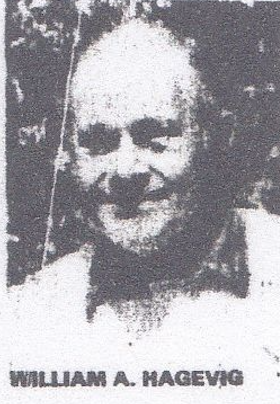
Primary Name: Hagevik, William A.
Filed as: hagevik_william_a
Also known as: Bill Hagevik; William Hagevig
Occupation / Association: Fire service instructor; Captain, Ketchikan Fire Department; State of Alaska Director of Fire Service Training
Born: January 17, 1930, Ketchikan, Alaska
Died: October 23, 1991, Douglas, Alaska
Parents:
Spouse: Rosemary Wagoner (m. 1962)
Children: Bill Hagevik; Barbara Hagevik-Doucet; Beth Hagevik; Ann Bogge; Karen Hagevik (d. infancy)
Associated places: Ketchikan, Alaska; Douglas, Alaska; Juneau, Alaska; Santa Cruz, California; Everett, Washington
Keywords: William A Hagevik, Bill Hagevik, William Hagevig, Ketchikan Fire Department captain, Alaska fire service training director, Southeast Fire Training Center Juneau, Alaska State Firefighter of the Year
Biography
William A. Hagevik was born on January 17, 1930 in Ketchikan, Alaska.
He graduated from Ketchikan High School and attended both the University of Washington and the University of Alaska Fairbanks.
In 1962 he married Rosemary Wagoner. They had five children: Bill Hagevik; Barbara Hagevik-Doucet; Beth Hagevik of Santa Cruz, California; Ann Bogge of Everett, Washington; and Karen, who died as an infant. Barbara later married Bill Doucet of Lake Stevens, Washington and had a daughter, Danielle Doucet.
Hagevik served as a captain in the Ketchikan Fire Department. In 1969 he moved to Douglas, Alaska and later worked for the State of Alaska as Director of Fire Service Training, retiring in 1985.
He created the first marine firefighting training center designed to simulate firefighting aboard a ship. The Southeast Fire Training Center in Juneau was later named in his honor. Hagevik was twice named Alaska State Firefighter of the Year, in 1966 and 1984, and in 1990 he was recognized nationally as Volunteer Firefighter of the Year. He was also an honorary member of several fire departments throughout Alaska.
He enjoyed fishing, hunting, studying history, and learning about the operation of masted sailing ships.
William A. Hagevik died at his home in Douglas, Alaska on October 23, 1991 from complications of diabetes at the age of 61. He was buried in the Douglas City Cemetery. Funeral services were held at the Cathedral of the Nativity.
Sources
Find-A-Grave memorial for William A. Hagevik
Tags: William A Hagevik, Bill Hagevik, William Hagevig, Ketchikan Fire Department, Alaska fire service training, Southeast Fire Training Center Juneau, Douglas Alaska residents
Benedict-Rice, Helen
Primary Name: Rice, Helen Benedict
Filed as: Rice, Helen Benedict
Also known as: Helen Benedict-Rice; Helen Benedict
Occupation / Association: Early Juneau resident; spouse of Episcopal missionary Dean Charles Edgar Rice
Associated places: Juneau, Alaska; Circle City, Alaska; Fairbanks, Alaska; Nashotah, Wisconsin; Milwaukee, Wisconsin
Keywords: Helen Benedict Rice, Helen Benedict-Rice, Charles Edgar Rice wife, Dean Rice family Juneau, Circle City Alaska missionary family, Fairbanks early families, Alaska Episcopal missions families
Biography
Helen Benedict married Charles Edgar Rice at the chapel of his alma mater in Nashotah, Wisconsin on August 30, 1906.
Following their wedding, the couple made the long journey back to Alaska, traveling to Circle City where Reverend Rice was serving as a missionary priest.
The couple had two sons. Their first child, Jackson Benedict Rice, was born June 15, 1907 in Fairbanks, Alaska. Their second son, Robert Gordon Rice, was born October 13, 1908 in Milwaukee, Wisconsin.
Helen Benedict Rice was part of the missionary family life that accompanied the Episcopal missions serving Alaska communities in the early twentieth century.
Sources
Biographies of Alaska Yukon Pioneers 1850–1950, Volume 2, pp. 272–273, Ed Ferrell.
Williams, Nathaniel
Primary Name: Samuel Albert
Filed as: Albert, Samuel
Associated places: Nenana, Alaska
Biography
On October 21, 1953, Samuel Albert was found lying beside a trail in the Native village near Nenana by Daniel Thomas.
A coroner's jury consisting of Alfred Linder, Nathaniel Williams, Solomon Like, and L. C. Olson determined that the death was a suicide by shooting.
Sources
- Local coroner's records
Linder, Alfred
Primary Name: Linder, Alfred
Filed as: linder_alfred
Also known as: Alfred Linder
Occupation / Association: Coroner’s Jury Member
Born:
Died:
Parents:
Spouse:
Children:
Associated places: Nenana, Alaska
Keywords: Alfred Linder, Linder Alfred, Nenana coroner jury, Alaska coroner jury, Nathaniel Williams, Solomon Like, L.C. Olson, Daniel Thomas
Biography
Alfred Linder served on a coroner’s jury in Nenana, Alaska. On October 21, 1953, Samuel Albert was found lying beside a trail in the Native village near Nenana by Daniel Thomas. A coroner's jury consisting of Alfred Linder, Nathaniel Williams, Solomon Like, and L.C. Olson determined that the death was a suicide by shooting.
Sources
Alaska coroner’s jury record, Nenana, Alaska, October 21, 1953
Tags: Alfred Linder, Linder Alfred, Nenana Alaska residents, Alaska coroner jury, Nathaniel Williams, Solomon Like, L.C. Olson, Daniel Thomas
Albert, Samuel
Primary Name: Albert, Samuel
Filed as: albert_samuel
Also known as: Private Samuel Albert
Occupation / Association: Veteran; Private; VFW burial
Born: March 6, 1920
Died: October 21, 1953
Parents:
Spouse:
Children:
Associated places: Tanana, Alaska; Nenana, Alaska; Douglas, Alaska
Property / Address: Douglas Indian Cemetery, Douglas, Alaska
Keywords: Samuel Albert, Private Samuel Albert, Albert Samuel, Tanana Alaska, Nenana Alaska, Douglas Indian Cemetery, Alaska Native veteran
Biography
Samuel Albert was born on March 6, 1920. He died on October 21, 1953.
He had a brother, Michael Albert of Tanana; an aunt, Mrs. Peter Clum of Fairbanks; and a cousin, Andy Kokrines of Tanana.
Albert was found lying beside a trail in the Native village near Nenana by Daniel Thomas. A coroner's jury consisting of Alfred Linder, Nathaniel Williams, Solomon Like, and L. C. Olson determined that the cause of death was suicide by shooting.
Albert was buried under the auspices of the VFW in the Douglas Indian Cemetery.
Sources
Find-A-Grave Memorial: Samuel Albert
Tags: Samuel Albert, Albert Samuel, Private Samuel Albert, Tanana Alaska, Nenana Alaska, Douglas Indian Cemetery, Alaska Native veterans
Dalton, James
Primary Name: Dalton, James W.
Filed as: dalton_james_w
Also known as: Jim Dalton; James Dalton
Occupation / Association: Engineer; Arctic exploration; U.S. Navy Seabees; Arctic Contractors
Born: 1913
Died: May 8, 1957, Fairbanks, Alaska
Parents: Jack Dalton; Anna Krippeahne-Dalton
Spouse: Kathleen “Mike” Fitzpatrick (m. 1950, Barrow, Alaska)
Children: George Dalton; Elizabeth “Libby” Dalton
Associated places: Fairbanks, Alaska; Dutch Harbor, Alaska; Barrow (Utqiaġvik), Alaska; North Slope, Alaska
Keywords: James W Dalton, Jim Dalton, Dalton Highway namesake, Arctic Contractors exploration, Naval Petroleum Reserve No 4 Alaska
Biography
James W. Dalton was born in 1913, the son of Alaska pioneer Jack Dalton and Anna Krippeahne-Dalton. He followed his father’s career in the North and eventually earned his own place in Alaska history.
Dalton returned to Alaska in the 1930s and earned an engineering degree from the University of Alaska in 1937.
During World War II he first worked for the U.S. Army Corps of Engineers in Fairbanks. He later served with the Naval Construction Battalions, commonly known as the Seabees, at Dutch Harbor and other locations in the Pacific theater.
After the war, from 1946 to 1953, Dalton worked with the quasi-government Arctic Contractors on the exploration of oil reserves held in trust for the U.S. Navy. The area, located on Alaska’s North Slope, was then known as Naval Petroleum Reserve No. 4.
James W. Dalton married Kathleen “Mike” Fitzpatrick in Barrow in 1950. The couple had two children, George and Elizabeth “Libby.”
Dalton died of a heart attack on May 8, 1957, in Fairbanks. The North Slope haul road running from the Yukon River to Point Barrow was later named the Dalton Highway in his honor.
Sources
Tags: James W Dalton, Jim Dalton, Dalton Highway, Jack Dalton family, Arctic Contractors, North Slope exploration
Dalton, Jack

Primary Name: Dalton, Jack
Filed as: dalton_jack
Also known as: Jack Dalton, Jack Miller
Occupation / Association: Freighter, Explorer, Entrepreneur, Klondike Transportation Pioneer
Born: June 25, 1856, Michigan (most probable)
Died: December 16, 1944, San Francisco, California
Parents: Unknown
Spouse: Anna Krippeahne Dalton; earlier unnamed spouse
Children: Jack Dalton Jr., Margaret Dalton, James W. Dalton, Josephine Dalton
Associated places: Juneau Alaska, Haines Alaska, Pyramid Harbor Alaska, Porcupine Mining District Alaska, Cordova Alaska, Yakutat Alaska, Chickaloon Alaska, Klondike Yukon
Keywords: Jack Dalton, Dalton Trail, Klondike freighting, Dalton Trail Company, Porcupine Mining District, Copper River Northwestern Railway
Biography
Jack Dalton's life of nearly ninety years spanned an era of extraordinary change in Alaska and the Yukon. As Alaska's premier freighter during the Gold Rush era, he witnessed the transition from pack animals and human labor to the mechanized age of railroads and aircraft.
Accounts of Dalton's early life are inconsistent. His birthplace has been listed as Oklahoma, Kansas, or the Cherokee Strip, but his California death certificate records that he was most likely born in Michigan on June 25, 1856.
Dalton had only a limited formal education but became largely self-educated through reading and writing. He possessed a wide range of practical frontier skills and developed a reputation as a formidable and capable man with a quick temper. He was known as a skilled horseman, hunter, cook, and boatman.
As a young man, he traveled widely across the American West, at one time using the name Jack Miller. By the early 1880s, he had moved to Burns, Oregon, where he operated a logging business. A violent altercation there resulted in the fatal shooting of a cook during a struggle, prompting Dalton to leave the area.
Dalton eventually traveled to San Francisco and joined a sealing ship bound for the Arctic coast. The crew was arrested for illegal sealing and jailed in Sitka. After gaining his freedom in the mid-1880s, Dalton remained in Alaska and quickly developed a reputation as a skilled wilderness guide and negotiator with Indigenous communities. He learned Chinook Jargon, the regional trade language of the Pacific Northwest.
In 1886, Dalton joined the Schwatka–New York Times expedition attempting to climb Mount St. Elias. The expedition reached approximately 5,700 feet before being forced to retreat due to illness. Dalton remained in the Yakutat region afterward, prospecting and exploring coastal areas around Disenchantment Bay.
In 1890, Dalton participated in the Frank Leslie Newspaper Expedition led by E. Hazard Wells with explorer E. J. Glave. The expedition crossed Chilkat Pass and explored interior river systems, including the Alsek River. Dalton and Glave became the first known non-Native explorers to descend the lower Alsek River by canoe.
During the early 1890s, Dalton pioneered the use of pack horses for transportation between the Alaska coast and the Yukon interior. He developed what became known as the Dalton Trail, running from Pyramid Harbor near present-day Haines across the coastal mountains toward the Yukon River.
The trail was completed before the Klondike Gold Rush of 1897 and quickly became a major transportation route. At its peak, trains of more than 250 horses carried freight and livestock to the goldfields. Dalton received permission from the U.S. government to collect tolls along portions of the trail while allowing Chilkat people to travel freely.
Dalton was closely associated with Juneau attorney John F. Malony, who frequently partnered with him in business ventures. Together, they operated the Dalton Trail Company, the Dalton Trading and Transportation Company, and the Dalton Pony Express Company.
Dalton also played a role in the development of the Porcupine mining district near Haines after gold was discovered there in 1898 by prospectors he had grubstaked. Dalton and partners established the Porcupine Trading Company to support mining operations.
Later, Dalton assisted with survey efforts for the construction of the Copper River and Northwestern Railway. His reconnaissance helped demonstrate that a rail route up the Copper River was feasible, eventually leading to the construction of a railroad to the Kennecott copper mines.
Dalton continued to work as a freighter and transportation contractor into the early twentieth century. In 1913, he undertook a difficult contract hauling 900 tons of coal from the Chickaloon mine to Cook Inlet for testing by the U.S. Navy. The expedition required constructing over forty miles of winter road and hauling coal by horse-drawn sleds.
Dalton later moved operations to Cordova, where he ran sawmills and transportation companies. In 1915, many of his Cordova holdings were purchased by interests associated with the Kennecott Copper Corporation.
Dalton married twice and had four children, including James W. Dalton, an engineer whose name was later given to the Dalton Highway on Alaska's North Slope.
After leaving Alaska, Dalton lived in the Seattle and San Francisco areas and even prospected for diamonds in British Guiana in the early 1920s.
Jack Dalton died in San Francisco on December 16, 1944, at the age of eighty-nine.
In 1942, the United States Army reopened portions of the historic Dalton Trail while constructing the Alaska-Canada Highway.
Sources
Berton, Pierre. Klondike: The Last Great Gold Rush 1896-1899. Coutts, R. C. Yukon Places and Names. Blakemore, F. B. Grit and Gold. Cracraft & Cole. A History of Coal Mining in the Sutton-Chickaloon Area. DeArmond, R. N. “Miners and Cattle Used Dalton's Trail.” DeLaguna, Frederica. Under Mt. St. Elias. Glave, E. J. “Our Alaska Expedition,” Frank Leslie's Illustrated Newspaper. Hakkinen, Elizabeth. Haines, the First Century. Russell, Israel C. An Expedition to Mt. St. Elias. Wier, Gary. “The Man Behind the Dalton Trail.” Alaska State Library Malony Files.
Tags: Jack Dalton, Dalton Trail, Alaska freighters, Klondike Gold Rush transportation, Haines Alaska history, Porcupine mining district, Copper River Northwestern Railway, Alaska pioneers, Alaska Mining Hall of Fame