
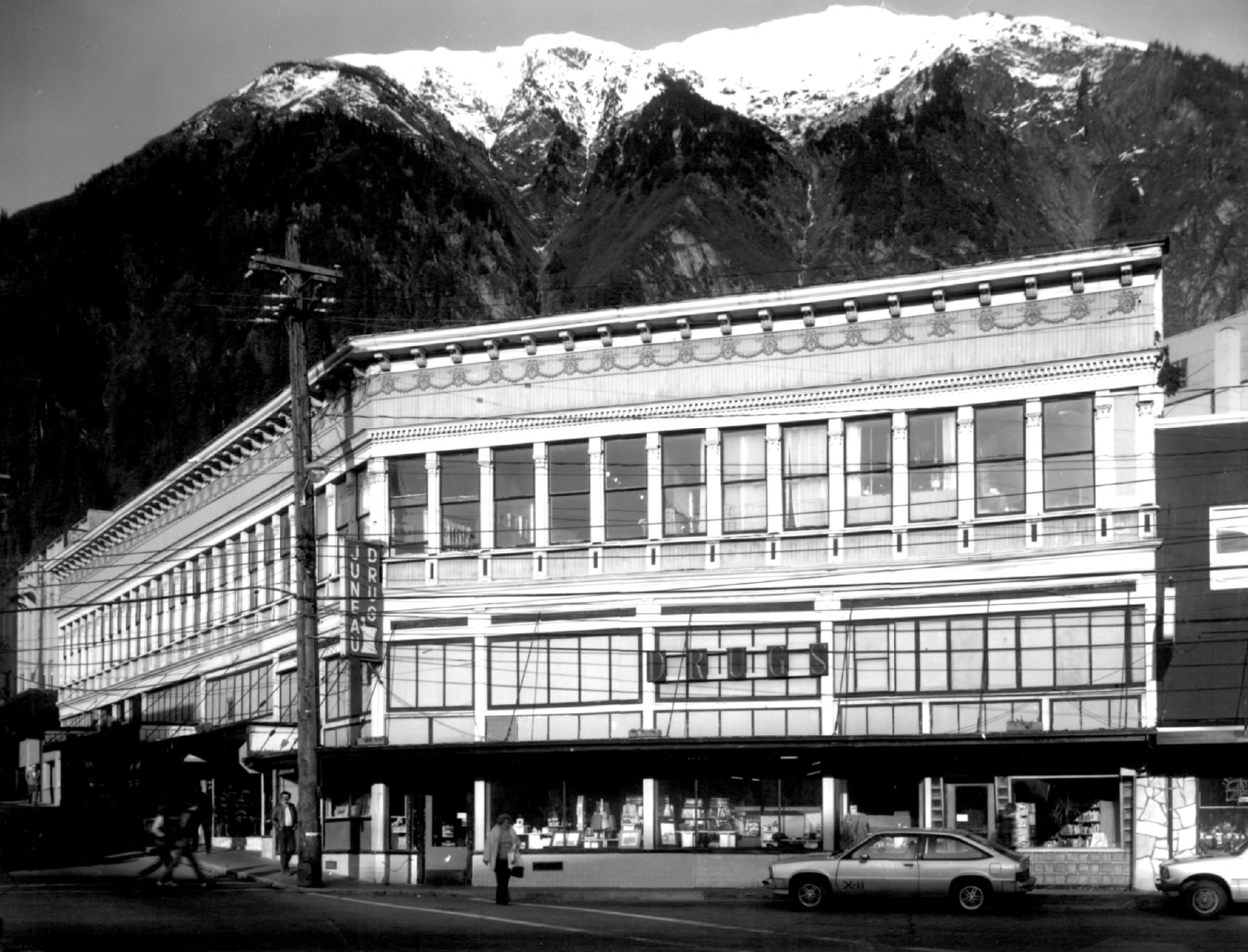
 The Valentine Building, built in two phases in 1904 and completed in 1913, is significant for its Frontier Alaskan architectural character, its recognized importance as Juneau's most prestigious office building
during the first half of this century, its association with Emery Valentine and other prominent pioneer Alaskans and significant historic events.
Emery Valentine arrived in Alaska in 1886, possessed of a strong degree of entrepreneurial ambition. At the age of 10, he had already crossed the midwest plains with his pioneering parents.
He followed the Rocky Mountain gold fields as prospector and miner, and lost a leg lost in an early Colorado Territory mining accident.
Still following the gold trails, Valentine arrived in the raw gold camp of Juneau only six years after that significant 1880 Gold Creek discovery by Joe Juneau and Richard T. Harris. He learned goldsmithing—which led him into the gold jewelry trade.
John Olds, one of the first sourdough prospectors following Juneau and Harris, recalled that,"We landed our canoe on November, 1880, at the foot of where Seward Street new is. . ." This site, just at the-tide mark, was registered, in 1881 as a mining claim, the Boston Lode.
In 1896, yhe year after Valentine's Alaskan arrival, Ernest Ingersoll's best-selling book, Gold Fields of the Klondyke, proclaimed "Juneau, a town of 3,000 is rightly called the metropolis of Alaska Territory. Whether she will retain this prestige remains to be seen. If so, one of two things must occur. She must plane down
the side of her mountains or erect skyscraping buildings with elevators to accommodate her populace, for nearly every foot of available ground is already occupied. . ."
Emery Valentine was foremost among the developers who found a better way.
When he arrived in Juneau, Front Street was the high tide beach of Gastineau Channel. Emery Valentine, accordingly, was among those who set progress by filling in ground along this derelict beachline. This enabled Valentine to build the first segment of his first building.
"Walking up the stairs to the second floor of the Valentine Building . . . is a trip back into what was the most prestigious business building of Juneau in the early 1900's, built by one of Juneau's colorful pioneer characters ..." according to Toni Croft & Phyllis Bradner's Touring Juneau; Back Streets, Bawdy-houses, Bars & Bodacious Biographies.
In 1913, the Valentine Building block was advantageously enlarged to include the prime corner lot at Seward and Front Streets. The 1904 structure not only doubled in size, but its impact was vastly enhanced by the most prominent corner location of two streets—rather than only one.
Emery Valentine had come to Alaska in 1886 to satisfy a lifelong desire to develop North America's "Last Frontier." Valentine founded Juneau's finest jewelry store which occupied the city's test retail site at the corner of Seward and Front with exposure on both streets.
Valentine became highly active in Alaskan politics and civic activities. He was Chairman of a city council-type organization called the Juneau Board of Safety, and underwriter and private financier for the first Juneau Fire Department. Valentine served six successful terms as Mayor after Juneau was incorporated in 1900.
Emery Valentine proved his deep commitment to development of Southeastern Alaska. As one of the largest property owners in southeastern Alaska, he helped found the Alaska Steamship Line, the foremost freight and passenger ocean line with service to Seattle. He founded the Peoples Wharf Company Docks at Skagway and Juneau, which so affected shipping charges in these ports, that coal and lumber prices dropped to almost half of the exorbitant rates paid before 1900.
Valentine wanted to erect "a quality structure that would give Juneau a truer air of urbanity."
The Valentine Building was the first in Alaska where office space was intentionally separated from retail space. The building's reputation for quality offices, gained over the years, and its ideal central downtown location, as well as architectural quality, provided elite tenancy for the first half of the century.
Architecturally, the Valentine building is an outstanding example of frontier Commercial architecture that recalls a pioneer Alaskan tradition of quality craftswork; the design responding and interpreting the contemporary architectural developments of the late 19th century West Coast.
Despite intentions to the contrary, the building is a vernacular one; yet impressive in its execution of style. The isolation of Juneau at that time, plus the popularity of pattern books as architectural design aids, provided the fine ornamentation of the building which was available from Seattle millworks).
Stylistically, Valentine Building provides documentation of an historic design evolution.
It was listed in the National Register of Historic Places in 1985.