
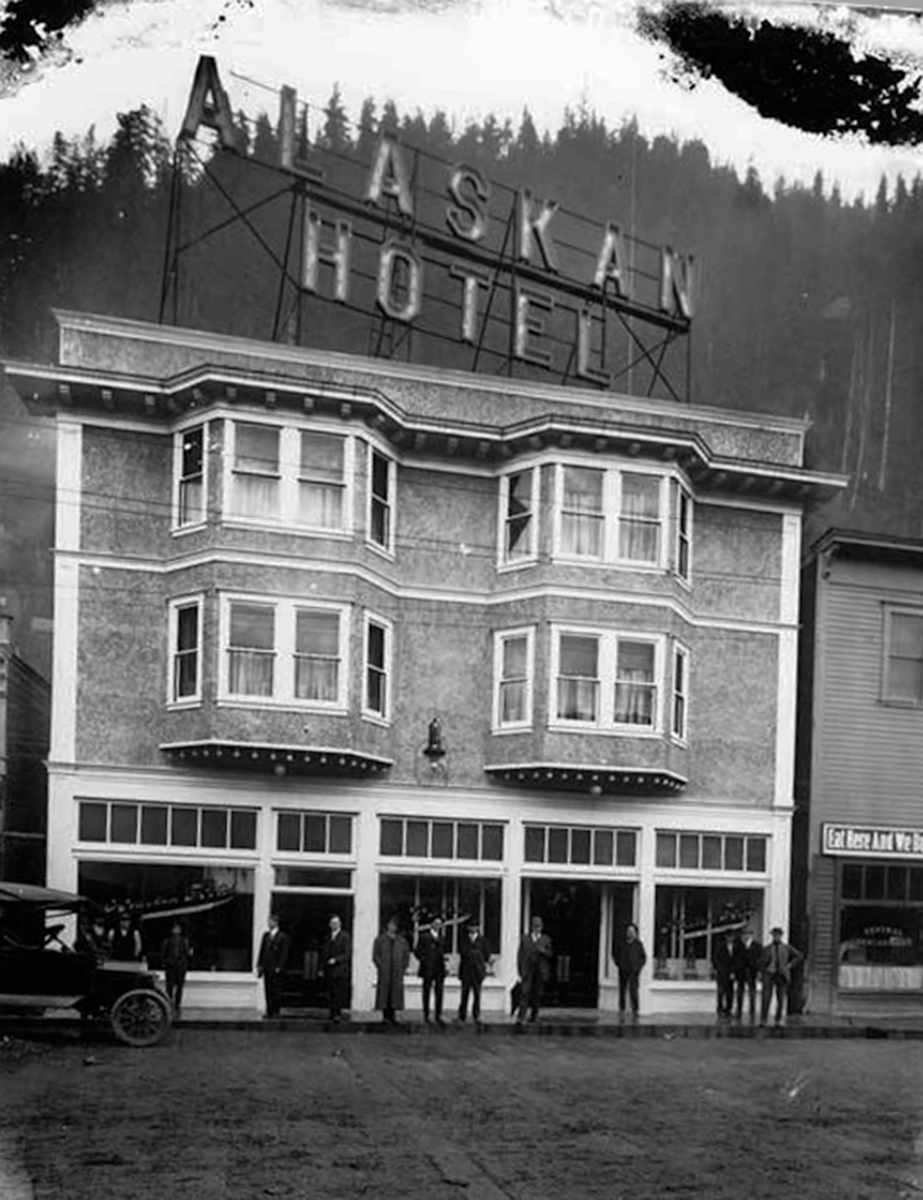
The Alaskan Hotel is the oldest operating hotel in the Capital City of Juneau, and is among the oldest in continous operation in Alaska.
It is associated with events that have made significant contributions to local and state history; and is an excellent architectural example of the transitional change between 19th and early 20th century.
Although Juneau came into being as a placer gold boom camp, in 1880, unlike many subsequent "boom and bust" camps, it became apparent that a city of some consequence would develop here. Placers, expectedly, were soon mined out; but the presence of vast deposits of quartz lode was established.
This developed into two large world- famous hard-rock mining and milling properties—the Treadwell Mines on adjacent Douglas Island, and the Alaska-Juneau Gold Mining Company —whose extensive surface works were within view of the Alaskan Hotel when it was built.
Juneau also diversified. It had five of the 27 newspapers in Alaska in 1907. It became a regional shipping and distribution point, with extensive docks and warehouses; fisheries, hydro-electric power, banking and lumbering adding to the economic affluence.
In 1900 the Territorial capital was moved from Sitka; Juneau also became one of the three District Court division headquarters; and in 1909, one of four. The City incorporated at that time.
The capital move from Sitka was slow, and occupied almost the first decade. Indeed the present capital building, although partially funded in 1911, was not completed until 1931.
A governor's mansion was planned, and several other executive buildings were built or leased, during the first decade, as government became an important part of Juneau's cosmopolitan life style.
By 1905 the population of Juneau and Douglas had exceeded 6,000 and was growing. The first Territorial Legislature convened in 1913. As a frontier mining camp, Juneau had developed a coterie of miner's boarding and rooming houses; but few hotels.
In the earliest years, the few transient hostelries— Franklin House, Caine, Circle City and Central Hotels were more in the pattern of sourdough roadhouses. Franklin House, and Caine were upgraded and the Occidental and Gastineau added. There was an obvious need for more modern and quality hostelries.
It was known that Marie Bergmann, associated with two of the older hotels since 1896, was seeking outside financing for a 64 room structure. Into this breach, in 1912, stepped an interesting triuvirate: Jules B. Caro, promoter-entrepreneur, and the McCloskey brothers, James and John.
Veteran miners of the Canadian Cariboo, the McCloskey's had finally struck a rich pay-streak in the $25,000,000 diggings at Atlin, across the mountains northeast of Juneau in British Columbia. They acquired a prime location, next door to the declining Central, in close proximity to the steamship docks and central to the business district.
Ground was broken in late 1912; and the well-furnished, attractive modern hotel opened with a champagne gala on September 1, 1913.
Its place in the community was noted in an editorial under the masthead of the Daily Alaska Dispatch:
THE NEW HOTEL The owners and lessees of the Alaskan Hotel are to be congratulated at giving Juneau a modern hostelry. Juneau has needed more hotels. Our old time favorite, the Occidental, has worked faithfully to accommodate an overflowing town during the past twelve months. With the new Caine hotel there should be ample hotel accommodations for the traveling public until next spring. There is room in Juneau for all the new hotels. All will do their share and the traveling public will not be forced to seek shelter here and there, much to their discomfort.
A pioneer resident—then a teenager—Trevor Davis, recalls his plate-glass observation of the exciting Grand Opening: the McCloskey brothers milling among a well-dressed crowd, shaking magnums of champagne, the corks aimed at the newly-installed chandeliers and the gleaming ceiling of the lobby. Thereafter the McCloskey's maintained an extremely low and silent profile.
 The Hotel opened under a management arrangement with P.L. Gemmett as President and Manager and F.H. McCoy, Secretary-Treasurer. In 1915, they were replaced by M.P. Goodman and E.E. Burlock, and in 1918 by a single manager, A.T. Spatz.
James McCloskey then assumed his first and only active management, for three years; until a long-term lease arrangement with local businessmen Charles Miller and Mike Pusich was announced.
After 18 months this was cancelled and Dave Housel assumed management until eventual sale by the McCloskey's. Management, thereafter, stabilized.
The Bergmann Hotel, which opened within four months after the Alaskan, quickly found its roll as an apartment-residential hotel. Later generations saw the building of the substantial Baranof, further up Franklin Street, and most recently The Prospector and Hilton.
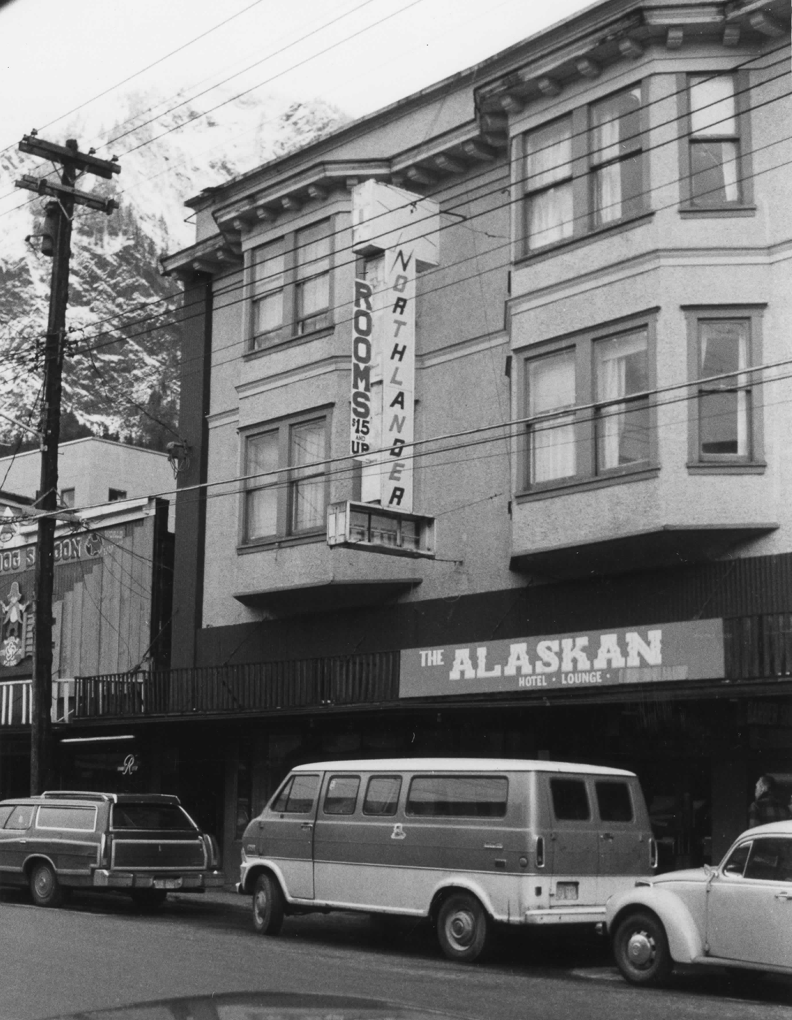
By this time the Alaskan had become the Northlander. Now under new management and its original name, a restored Alaskan Hotel looks forward to perpetuating its landmark status into the second century of Juneau's history.