
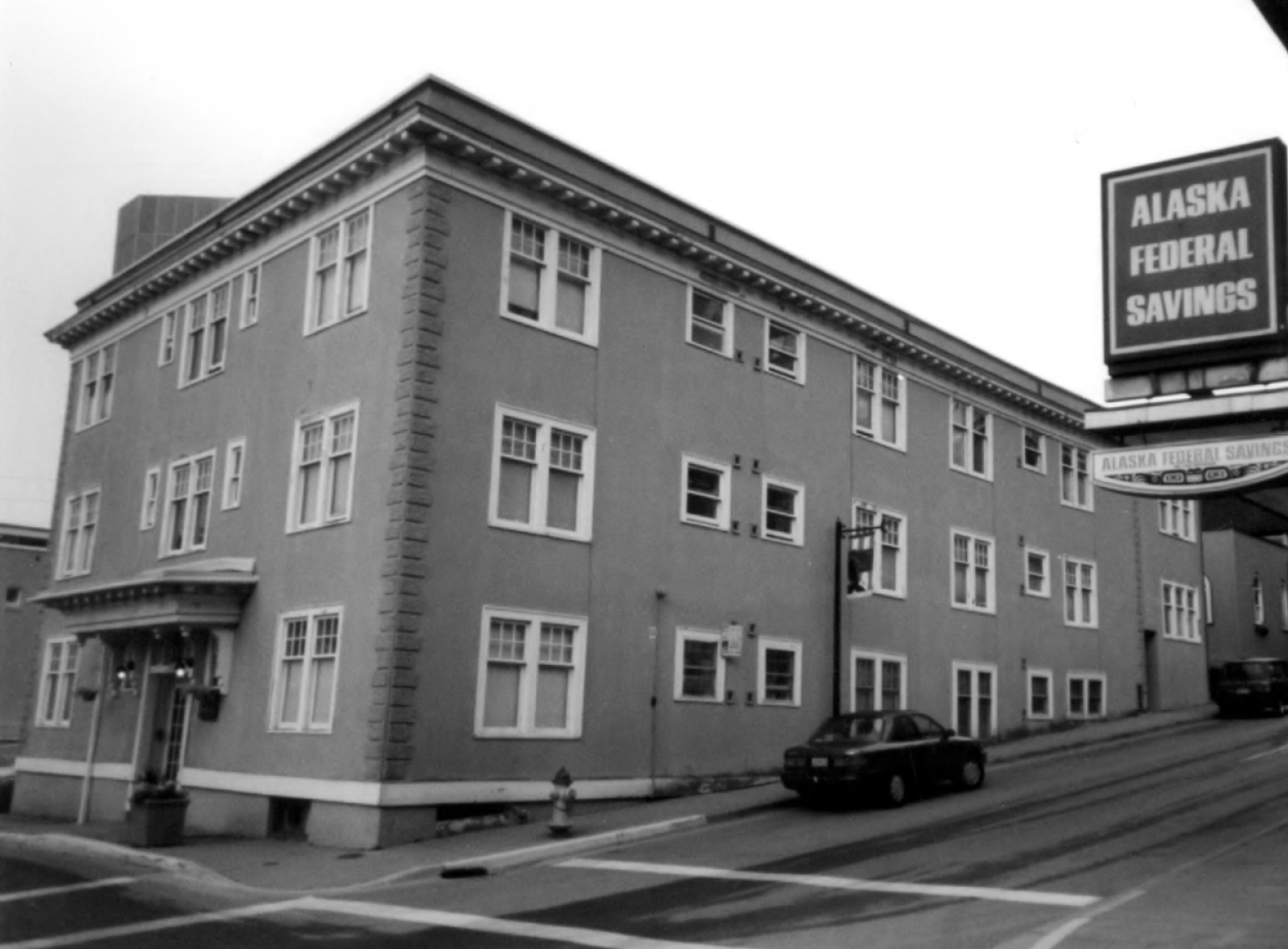
 The MacKinnon Apartments is a historic apartment building at 236 Third Street. The building is a three-story wood-frame structure, finished in stucco with corner quoining and a dentillated cornice.
The MacKinnon Apartments provided modern housing in Alaska's capital and largest city, and is representative of the size and scale of the buildings constructed during the boom that occurred in Juneau during the 1920s.
When it opened in 1925, it was 80 feet (24 m) long and housed six single-bedroom and 12 studio apartments. In 1959, 20 feet (6.1 m) allowed five more studio units to be added. The building is representative of Juneau's boom years in the period between World Wars I and II, 1921 to 1939, which been defined as Juneau's Peak Gold Mining Era.
During that period, the town was the center for the territorial government, for the Alaska-Juneau Gold Mining Company's huge hard rock operations, for salmon and halibut commercial fishermen, and for supplying southeast Alaska.
Following placer gold discoveries in Silver Bow Basin in 1880, prospectors and businessmen established the town of Juneau. Within a decade, companies organized to mine the hard rock gold deposits in the area. Between 1880 and 1944, the three major mining companies in the Juneau area produced $158 million in gold. The Alaska Juneau Gold Mining Company was the largest low grade ore gold producer in the world from 1910 to 1944.
Juneau quickly grew to be the largest community in southeast Alaska. In 1920, with a population of 3,058, it was the largest city in Alaska. The federal government designated Juneau the capital for the District of Alaska in 1900, although the move from Sitka was not made until 1906, and in 1912 designated it the capital for the Territory of Alaska.
After a cold storage plant opened in 1913, Juneau became the home port for a number of fishermen. The timber industry flourished with the building of a sawmill around 1910. Juneau became the regional trading center for communities in southeast Alaska. Steamships arrived and departed regularly.
In the summer months, steamships brought visitors to town. World War I created shortages of skilled labor to work in the mines and materials needed for mine operations. Production slowed. After the war, with new capital and improvements in technology, the Alaska-Juneau Gold Mining Company was profitable and expanding operations. As a result, the town prospered. Juneau business people invested in new, more substantial buildings. One of the new buildings was the three story MacKinnon Apartments.
Lauchlin "Lockie" MacKinnon, an immigrant from Nova Scotia, constructed the apartment building. He came to Alaska in 1886, MacKinnon drifted around mining camps in Alaska and the Yukon, working as a miner and businessman. For a few years in the 1890s he mined at Porcupine north of Haines. In 1893, he crossed the Chilkoot Trail to seek gold in the Fortymile.
Back in Juneau, in 1895 and 1896 he and George Miller, his partner at Porcupine, built and operated the Circle City Hotel on Third Street. The hotel had eighty rooms, a bar and dining room.
He married Martha Maline Lokke, who came to work at the hotel, in April 1896. The family continued to move around the north, spending several years at Atlin, B.C. and in the Fairbanks area, before settling in Juneau around 1911. Back in Juneau, MacKinnon managed the Zynda Hotel, later known as the Juneau Hotel, on Main Street.
In the 1920s, MacKinnon sensed that apartments were replacing boarding houses and hotels, and built the MacKinnon Apartments. He and his wife lived in an apartment in the building until their deaths in the late 1940s.
The MacKinnon Investment Company prospectus appeared August 17, 1925, seeking investors in a three-story frame apartment house to be located at the corner of Third and Franklin Streets.
An article in Stroller's Weekly, a local newspaper, dated October 10, 1925, noted that the new MacKinnon Apartments offered numerous modern conveniences. In particular, the article said the builder wired each apartment for electricity.
After his second term as territorial governor ended in 1933, George Parks lived in the MacKinnon Apartments for three years. The building has been continuously used as an apartment house since construction.
Sons J. Simpson MacKinnon and Donald L. MacKinnon operated the apartment house after their parents' deaths. In 1959, perhaps anticipating the increased need for housing in the new state's capital, they added five studio units to the back of the building. Other than this addition, the building has not been significantly changed since its construction.
The apartment building is located two blocks outside of the Juneau Downtown Historic District, which were listed in the National Register of Historic Places in 1994. The McKinnon Apartments were listed on the National Register of Historic Places in 2000.