
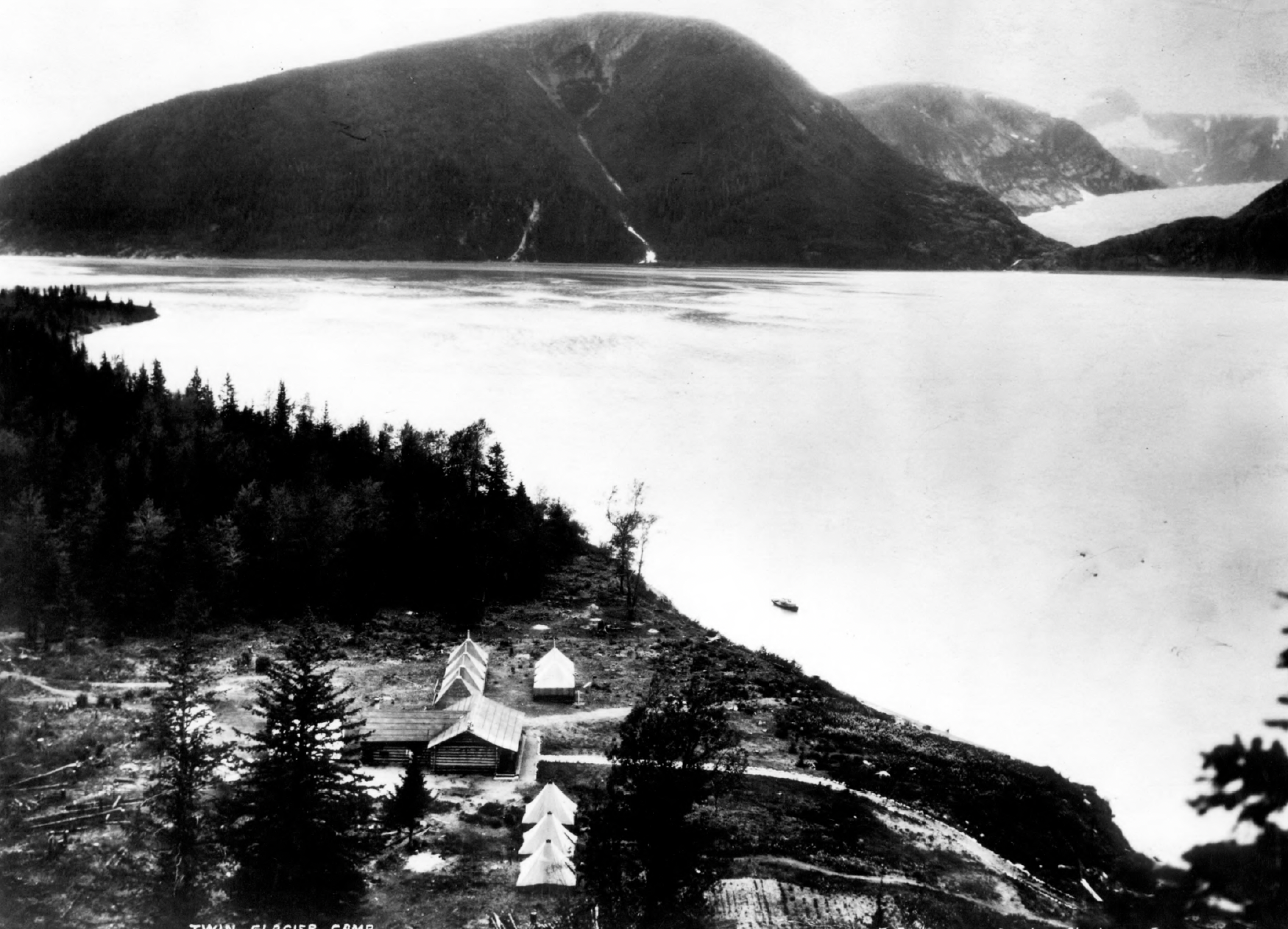
 Twin Glacier Camp, 30 miles northeast of Juneau, opened in 1923. From the site visitors could view the nearby glacier, hike, hunt and fish, and enjoy the Alaska wilderness.
The camp was built and operated by the Taku River Trading Company, a commercial venture of Alaska physician and businessman Harry Carlos DeVigne. It is one of a number of wilderness camps and lodges that opened around Alaska during the 1920s when the visitor, fishing, and big game hunting industries greatly expanded.
Visitors began traveling to Alaska to view its scenic beauty, wildlife, and Native cultures in the 1870s. Before the end of the century, four steamship companies serving Alaska were advertising tours through southeast Alaska's Inside Passage. These tours included viewing and walking on glaciers in their itineraries.
The most accessible and popular glaciers in southeast Alaska was Taku Glacier, described in tourists as "two miles wide and 300 feet high, gleaming in green and blue." After World War I, the Alaska tourist industry rapidly expanded. More people became visiting Alaska as its big game hunting and fishing opportunities became better known, and as these opportunities became more limited in the western United States. A nationwide boom in leisure activity and a multiplication of Alaska travel routes lured people northward in dramatically increasing numbers.
Alaskans began to reap substantial financial benefits from tourism as visitors began to explore more of Alaska than could be seen from the deck of a steamship. Originally a gold rush town and then the territory's capital, Juneau attracted a number of visitors. Local residents supported the establishment of a territorial museum in 1921. Others began to offer excursion packages to fishing and hunting sites or to view the area's natural beauty.
Advertisements of excursion trips from Juneau to Taku Glacier appeared in the Alaska Daily Empire in 1919 and 1920. Dynes' Tours of Alaska in 1921 not only extolled the beauty of the glacier, but said: "The Taku Region abounds in large game of all species for the hunter and angler. In an hour he can fill his bucket with large cutthroat trout."Two lodges have been built here by Winter and Pond, photographers of Juneau, who run excursions to this point almost every week in the summer season."
Twin Glacier Camp retains its integrity of location because none of the buildings has been moved. Integrity of design has also been maintained. The contributing buildings have undergone minor modifications but their massing, outline, materials, color, and finishes are still those of the original buildings.
The non-contributing buildings complement the original buildings in the historic district. While their design is compatible with the original ones, the non-contributing buildings do not imitate the older ones.
Integrity of setting has been maintained. The wilderness location is virtually unchanged from the 1920-1930 period. Twin Glacier Camp remains an isolated hunting, fishing, and recreational lodge; not even the trails and paths have been paved. Integrity of materials and workmanship has been kept.
The buildings have been well-maintained, a few, minor changes have been made with appropriate materials to both the contributing and non-contributing buildings. The camp evokes the feelings of a comfortable lodge, where people are free from distractions and can focus on a healthy, outdoor lifestyle. There is little about the camp or its setting to detract from Integrity of feeling or association.