
A 1995 historic sites and structures inventory identified three non-continuous cemetery sites on Douglas, known generally as the Douglas Catholic Cemetery, Eagles Cemetery, and the Douglas Indian Cemetery.
All three cemeteries are located along Douglas Highway within a mile and a half of each other. While documenting the cemeteries, it was uncovered that two of the cemeteries were actually made up of a grouping of smaller cemeteries.
The Catholic Cemetery includes the Catholic Cemetery, the Odd Fellows Cemetery, the Masons Cemetery, the Native Cemetery, the Asian Cemetery, and the Russian Orthodox Cemetery.
The Eagles Cemetery is made up of the Douglas City Cemetery, the Eagles Cemetery, and the Servian Cemetery.
There was no cemetery in Douglas in the early 1880's and 1890's. In 1887 there were no newspapers except in Juneau and little mention was made of deaths in Douglas or Treadwell, unless it was a major mine accident. The Douglas Island News was established in 1898 and vital statistics were recorded.
One article states that Douglas people were buried in Juneau before 1900. Some may have been buried in the "Ridge Cemetery" (Chicken Ridge) as early as 1887 and in the Evergreen Cemetery which was developed in 1888-89. A few deaths were recorded in 1899, and in August of 1900 people were reported as being "buried in the old cemetery." It is not clear whether or not they meant Douglas. There may have been some burials near the outskirts of town before the establishment of the "new" cemetery.
The first issue of the Douglas Island News in 1898 stated that a movement to start a cemetery occurred at a public meeting. In the August 1900 issue the editor commented, "In constructing a cemetery on Douglas Island a very peculiar condition presents itself Will Douglas citizens bury their dead on Douglas Island?" He goes on to say that there "are numerous graves tended and fenced by Douglas relatives (in Juneau) and would families want to be separated." The old cemetery was known all over Alaska as the Juneau-Douglas Cemetery. Yet the citizens of Douglas wanted their own burial ground.
 In 1899 mining engineer W.A Sanders, W.A Thompson, and Minnie Ross Holman applied for a patent to mining claims which took in the northwest end of the town of Douglas, including streets and buildings. The ground consisted of over 50 acres which included 13 lode claims and some mill sites. A committee was formed to protest this patent.
Sanders agreed that if the committee did not protest his application for patent he would deed back "all lots, easement of streets, etc. and other points in which his patent interfered with the town of Douglas." This was later agreed to in writing.
The committee asked for ground for a cemetery. Sanders agreed to give the people of Douglas "the dry knoll this side of Lawson Creek" if they would not object to his patent.
He also agreed to build a road to the grounds, but declined to put it in writing and said his word was good.
Immediately after the meeting, a Cemetery Committee consisting of P.H. Fox, M.J. O'Connor, Reverand Peplogle and W.C. Boyd took possession of the knoll and ran a line from Third Street in Douglas to the area.
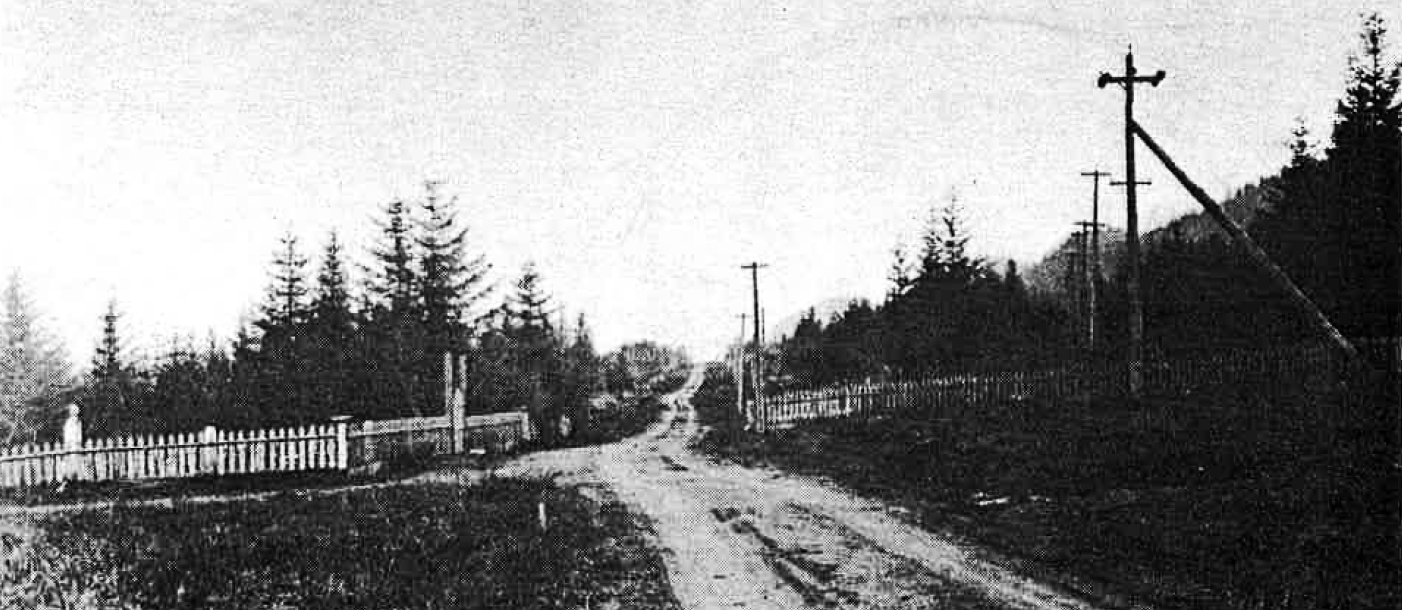
Shortly after Sander's verbal agreement the Cemetery Committee hired three men and started clearing a trail, which later became a gravel road, from Third Street in Douglas to the knoll.
The land claimed was "to the left' of the gravel road on the bench from the gulch where the road strikes the bench, to Lawson Creek." The road was approximately one-half mile in a straight line. About 30 feet of planking was done from the end of Third Street to the "Old Indian Graveyard" (Douglas Indian Cemetery) and three small bridges were constructed. Two acres were cleared and between four and five acres were enclosed by a wire fence. This description fits the location of the current City Cemetery.
Though W.A Sanders was a noted mining engineer, it was felt among the citizens of Douglas the Sanders' claims were not valid because he was a resident of Nova Scotia, Canada. Apparently the patent office did not agree. In 1900, Sanders obtained a patent to part of the mining claims.
He kept his written word and deeded back the land and buildings, but refused to honor his verbal agreement regarding the cemetery, in fact he denied making it.
Eventually he admitted he had made the agreement but "he wasn't going to buy land and pay out money for it and then give it away." Mr. Sanders was informed that the people of Douglas had earned the cemetery ground because they did not interfere with his patent. They even offered to pay him the government price of $5.00 an acre. He did not feel that was enough. It is not stated what the final outcome was.
Sanders did post no trespassing notices as late as 1903 threatening to prosecute any person using the ground for burial purposes, but they soon disappeared. Douglas residents claimed that they had been in "legal and peaceable possession of the premises for about three years."
Fund drives began in 1900 to raise money to pay for the gravel road and other improvements. Over $1,000 was collected in two months through musical benefits and subscriptions. Donations were as high as $30 per individual when the average day's wage was around $3.00.
The cemetery land was eventually divided into nine sections which were sold to various groups. The main ones being the City Cemetery, Eagles, Odd Fellows, Masons, and Catholics. Smaller sections were dedicated to the Servians, Asians, Natives, Russian Orthodox and one source claims there were separate sections for prostitutes and suicides.
In November 1900 pioneer Douglas resident W.C. Boyd was appointed clerk for the Cemetery Committee and was to keep all records. He also was in charge of the road gang and later appointed as grave digger because previous diggers were not "observing the plan of the streets and alleys as marked out."
Persons wishing to bury their dead in the Douglas Cemetery were required to apply for a permit with the description of the deceased, name, age, and birth place. Records were kept for future use.
A charge of $5.00 was made for a burial permit and a plot (this fee was still in affect as late as 1933). Families could secure a lot sufficient for five burials for $10.00. Societies (lodges, etc.) could obtain a lot from $50.00 upwards, depending upon the size. The ground was to be cleared and fenced and a yearly fee was charged for road repairs and other maintenance.
One source reported that in 1907 there was unrest at Treadwell because of rumors that if a man died and had no relatives, his body would end up in the mill tailings piles. That same year John Yamanoi, a Japanese kitchen worker was murdered. A week later the "Treadwell Funeral Riots" began. The men demanded special caskets and funerals complete with the Treadwell Band, marked graves and notification of their deaths to their relatives. In 1913 the Treadwell Company agreed to funeral expenses not to exceed $125 per interment.
There were over eight mining related deaths at the Treadwell mines in 1901. The greatest loss of life was on March 2, 1910 at 11:30 PM on the 1,100 foot level of the Mexican Mine when the powder magazine exploded. The men were gathered at their station wiring to be hoisted to the surface for their midnight meal. All 36 men died except one who was badly injured. At the 900 foot level a man was killed by the shock of the explosion and others were injured.
Numerous graves have been found in the city cemetery and one in the native cemetery of these mining accident victims. The average age of the 1910 victims was twenty and most of them appeared to be single. The men were from all over the world including Austria, Italy, England, Norway, and Finland Only two were listed as being from the United States.
There were no morticians as we know them today. Cabinet shops were established that included the making of furniture and caskets. The owners of these shops became the undertakers for the town. Advertisements were in the Douglas Island News reading "Undertaking ... Manufacturers of Furniture, Carpentering, Jobbing, Store & Office Fixtures."
Others read, "Douglas Undertaking Parlors, Funeral Directors and Embalmers." Some of these undertakers were H.V. Sully, POA Juneau Igloo Charter Member John.A McKanna, T.P. Sheldon, and L.G. Thomas and Merle Thomas. Some of the deceased were shipped to Juneau to C.W. Young and POA Juneau Igloo President Charles W. Carter and then returned to Douglas for burial.
Laura McCarley, author of "Treadwell, Alaska" says that blanket burials in unmarked graves were the standard practice of the mining companies. She also reports that the new Douglas cemetery, presumably the City Cemetery, was laid out in 20' by 20' plots, with streets and alley ways and that a German cabinet maker and hardware merchant, John Feusi, went into
the undertaking business. Reportedly a partially blind Tlingit from the Taku Village, Frank Weaver, was carving tombstones out of Tolkeen Marble.
An undetermined number of graves in the Servian, Asian, and Native cemeteries were moved when the Bureau of Public Roads constructed Douglas Highway to Cowee Creek in 1934. A news article stated that the bodies were interred in the present City Cemetery.
In February 1937 disaster struck as a fire burned businesses on Front Street and moved up D Street into the heart of the townsite along Third Street. Blocks of business property were destroyed along with the school, city offices, churches, and many residences. Among the items burned were the city records dating back to the 1890's. 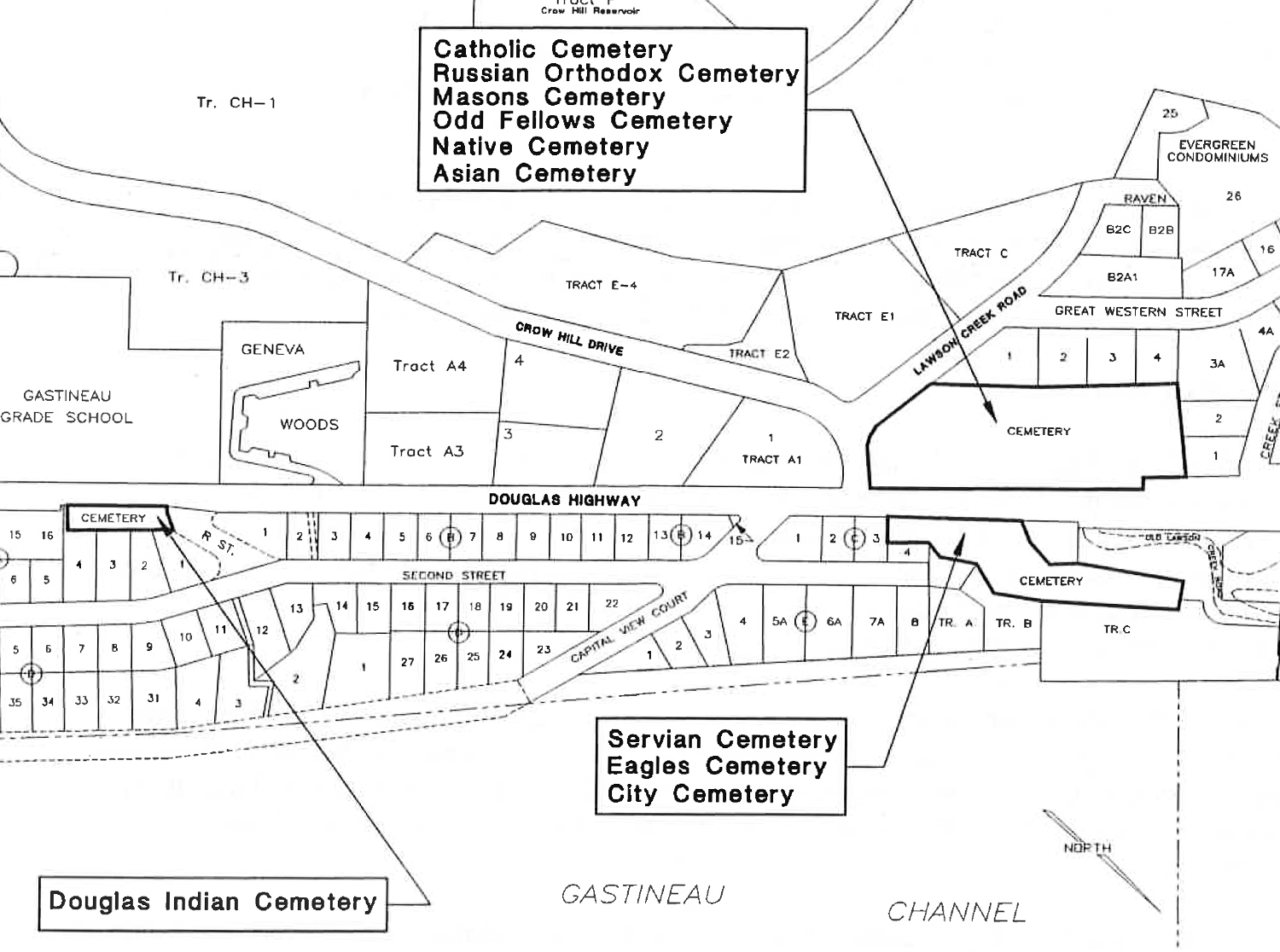
Among them were vital statistics records from 1909 to 1920; old cemetery records by W. Boyd from 1900 to 1910; numerous burial lists, records and papers; revised cemetery record 1927; and chart and burial lot plat of the cemetery.
In 1967, due to a road project, eight graves containing 13 bodies in the Douglas Indian Cemetery were removed and interred at Evergreen Cemetery in Juneau.
In 1972 graves were disturbed at the Eagles Cemetery due to the widening of Douglas Highway. About 25 graves were moved to Alaska Memorial Park in the Mendenhall Valley. The exact number of burial sites disturbed or moved is difficult to document as the records are not readily accessible or don't exist.
In the early 1970's the City and Borough of Juneau agreed to survey cemetery land in Douglas as part of an effort to investigate, clear title to the property, and gather information to acquire, survey and maintain the cemeteries.
One assemblyman agreed that an inventory should be made and that the city should assume responsibility for the Douglas land. It was even suggested that additional land around the cemetery be purchased to accommodate new burial sites.
It was also suggested that individuals who had relatives in the cemetery be asked to maintain the grave sites or donate money to have them maintained.
The Ross Estate was to be contacted and asked for transfer of ownership of the cemetery land. If they could not be contacted, a quiet title action was to be initiated and the grave sites were to be inventoried. There is no evidence that the Ross Estate was ever contacted and the quiet title action has never been completed.
In July of 1979 foundations were being constructed for a private home allegedly on the western edge of the City Cemetery. The owners of the property in question reportedly took extraordinary measures to make certain there was no problem. A group of Douglas residents were extremely upset, and tried to halt construction.
The attorney for the individuals said there was no evidence that the site was part of the Douglas Cemetery, even though the house is surrounded by graves.
Investigations were made by the Alaska State Troopers and the State Attorney General's office. An archaeologist was also called in to investigate.
It was later proved that the house was not within the cemetery boundaries. The proof sought was a quiet title action, dated in 1964, by the O.T. Corporation versus the City of Douglas that indicated the land was not part of a cemetery.
In the judgement and decree of the court the O.T. Corporation got title to the lot which was eventually sold. The lot was described as adjacent to but not in a cemetery.
During the controversy, numerous Douglas residents turned out to clean away the brush and debris in the Douglas Cemetery. Residents also asked the Borough Assembly to stop the construction project, but this request was turned down.
Survey and Inventory of Douglas Historic Cemeteries
Alaska Native Brotherhood & Alaska Native Sisterhood Resolution
Pioneers of Alaska Resolution in Support of CBJ Taking over Care of Cemeteries