
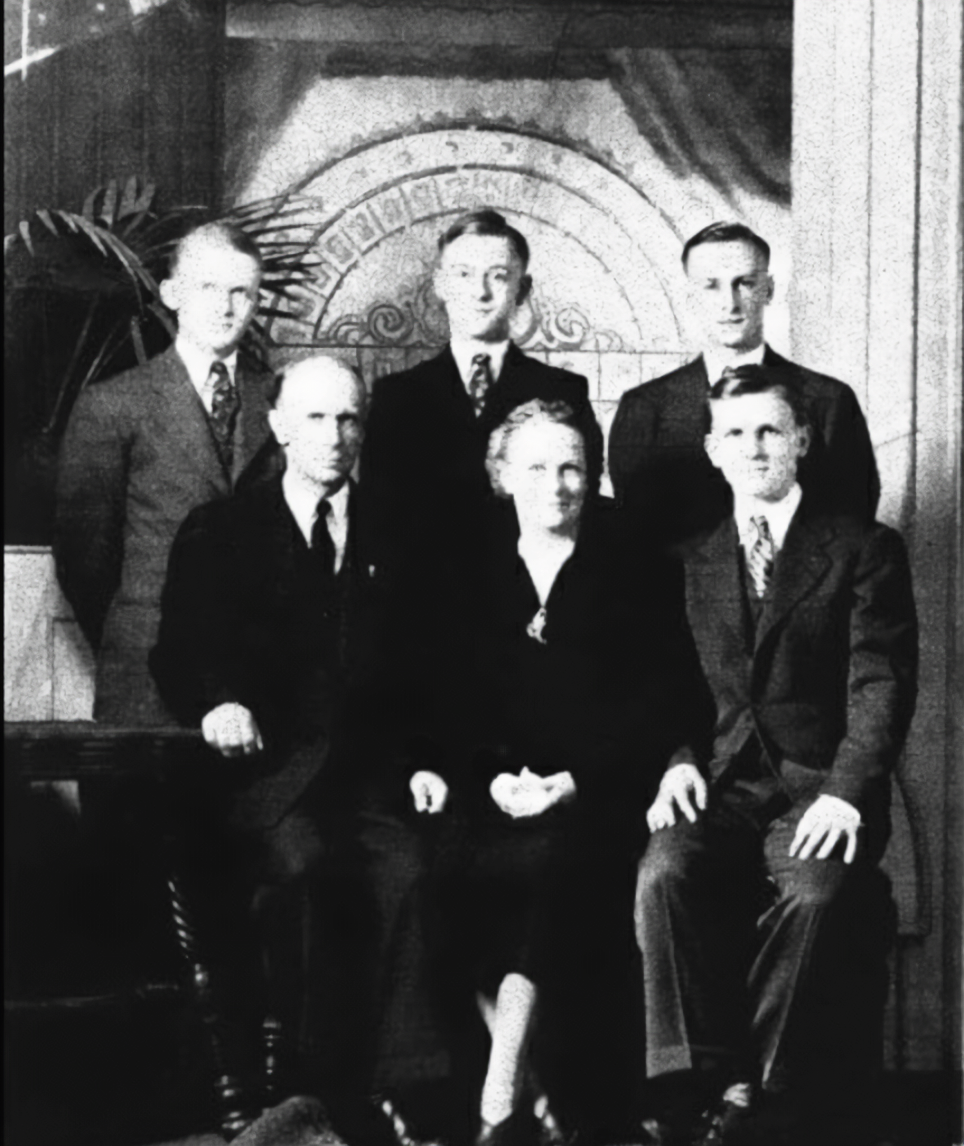
Zenger family portrait, Juneau, Alaska. Sebastian, Carrie, and Alfred Zenger Sr. and family, 1941.
Primary Name: Zenger, Al
Filed as: Zenger, Al
Also known as: Alfred Zenger Sr.; Al Zenger Sr.
Occupation / Association: President, Juneau Men's Igloo; cigar manufacturer; accountant; Alaska Juneau Gold Mine employee; U.S. Navy Reserve veteran
Associated places: Juneau, Alaska; Douglas, Alaska; Seattle, Washington; Sutton, Alaska; Tenakee, Alaska; Sitka, Alaska; Point Louisa, Alaska; Cook Inlet, Alaska; Dyea, Alaska
Keywords: Zenger family, Alfred Zenger Sr., Sebastian B. Zenger, Juneau pioneers, early Juneau families, Pioneers of Alaska, Juneau Men's Igloo, cigar manufacturing in Alaska, Alaska Juneau Gold Mine, U.S. Navy Reserve, Dyea Trail, Klondike era settlers, Alaska territorial history
Biography
Alfred “Al” Zenger Sr. was an early Juneau resident, businessman, veteran, and community leader who served as President of the Pioneers of Alaska Juneau Men’s Igloo in 1948. He was the son of Sebastian B. Zenger, a Bavarian immigrant whose family became part of the fabric of early Juneau civic and commercial life.
Sebastian B. Zenger was born on March 18, 1862, in Kallmuenz, Bavaria. He immigrated to the United States when he was nineteen years old. He first came to Alaska in 1896, going to the Cook Inlet district. When the stampede to the Klondike began in 1897, he went to Dyea, where he packed for wages on the Dyea Trail in 1897 and 1898. He left Seattle in 1897 by steamship for Juneau in search of work. In October 1898, Sebastian moved his wife, Carrie, and children, Bertha, Alfred Sr., Theresa, and Hilda, to Juneau, where he was employed as a carpenter.
Through family friends, a romance blossomed between Sebastian’s eldest daughter, Bertha, and Joseph Trudgeon, a young merchant and co-owner of a dairy farm in Douglas. Joseph was born in 1879 in Quebec, England, to Joseph Trudgeon and Josepiah Ruth Haydon. Bertha and Joseph were married in Douglas in 1906.
In Juneau, the Zenger family resided for nearly a decade, from about 1910, on the second floor of a two-story wooden-frame building at the southwest corner of Third and Main Streets. The first floor was occupied by the manufacture of cigars. That structure later had a colorful history, serving at different times as a dance hall and later as a church space. It housed the Resurrection Lutheran Church from the 1930s to the mid-1950s, when a new church building was constructed at Glacier Avenue and 10th Street. In the 1960s, the building was razed to widen Main Street.
Sebastian and his son Alfred manufactured a variety of cigars in Juneau. The basswood molds used in that work were reportedly burned as firewood sometime in 1932, though by the 1990s, such molds had become desirable antique items. Tobacco for the manufacture of handmade cigars arrived in hogsheads by steamboat. Ships usually made monthly, and later biweekly, runs through Southeast Alaska before returning to Seattle. These vessels were the lifelines of the communities for every need. Livestock arrived alive and were slaughtered on the dock as needed, and butter was shipped in kegs packed in salt brine because ships of that era lacked refrigeration.
In the early summer of 1910, Sebastian sent his son Alfred to check on a mining venture in which he had invested at Sutton in the Matanuska Valley. Alfred departed Juneau aboard the steamer Star of Seattle. While on the Gulf of Alaska, a storm raged so severely that he saw the same point of land for three consecutive days. Upon arrival at Portage on the Kenai Peninsula, he hiked over the portage to the head of Cook Inlet, where Anchorage now stands. At that time, there was only one cabin on the beach. Throughout their lives, Sebastian and Alfred became involved in various ventures in hopes of striking it rich, grubstaking, or putting up venture capital for assorted enterprises.
About 1914, a romance flourished between Theresa Zenger and Hubert C. Huehn, a linotype operator for the Daily Dispatch. Hubert was the son of John Esch Huehn and Amelia Lundy, born in 1890 in Morden, Manitoba, Canada. Theresa and Hubert were married in Douglas in 1914 and later moved to California.
In 1916, Sebastian’s youngest daughter, Hilda, married Eugene Allen Rowe, the son of Richard Valentine Rowe and Maria Z. Miller. Eugene was born in 1894 in Madison, Dane County, Wisconsin. In 1919, that couple moved to Seattle.
During World War I, Alfred enlisted in the Navy Reserve in Seattle in 1917 and attended the first U.S. Navy class in radio-telephone at Cambridge, Massachusetts. Upon graduation, he was assigned to the Naval Training Center in Seattle to teach radio-telephone operations. He was released from active duty in 1918 and discharged from the Naval Reserve in 1921.
While on active duty with the Navy in Seattle, Alfred met Silva Ann Redman through relatives. She was born in 1898 in Seattle, King County, Washington, the ninth of ten children of John David and Emilia Redman. The couple married in Seattle in 1919. Shortly after the wedding, they left for Juneau, honeymooning at Tenakee and Sitka.
According to the 1920 census, no Zengers were residing in Juneau, suggesting a division in the family between those who wished to remain stateside in Seattle and those who desired to remain in Juneau. In early 1920, Sebastian again took up residence in Juneau at 121 West Fourth Street at the corner of Calhoun Avenue. Alfred and Silva resided in a small apartment upstairs. During the early 1920s, Sebastian opened and operated a curio shop on South Franklin Street, continuing until his death in 1932. After spending the summer of 1932 at the family’s cabin near Point Louisa, approximately sixteen miles from Juneau, the family again took up residence in the grandfather’s home on Calhoun Avenue.
As the territorial government expanded, the demand for office space in Juneau increased. The City of Juneau gave land for an office building on the site of the city hall and the old Arctic Brotherhood Building. The new structure was to face Main Street between Third and Fourth Streets. Alfred and Silva were not pleased by the prospect of a four- or five-story office building being erected next to their home. During excavation, blasting by the contractor’s powder man damaged the Zenger residence, the Cooper Building, and automobiles across Main Street. Damages were repaired, and the house remained in the Zenger family possession until 1965.
Alfred and Silva remained in Juneau, where their children were born: Alfred Jr. in 1920, Harold in 1922, Ned in 1925, and Chester in 1927. Alfred Sr. worked at various times as a cigar maker in Seattle and Juneau. He also found employment at the Alaska Juneau Gold Mine as a flume keeper. After taking correspondence courses to become an accountant, he worked for the Sanitary Grocery on Front Street, Connors Motor on South Franklin Street, and Empire Printing Company on Main and Second Streets. In 1950, he traveled to Germany to visit his family. Upon his return to Juneau, he obtained temporary employment with the Veterans Administration and later with the Department of Alaska American Legion. He held these positions at the time of his death in Juneau in 1954. He was buried in Evergreen Cemetery in the American Legion Plot.
After Alfred Sr.’s death, Silva married Robert H. Hanson in 1962 in Fall City, Washington, where they resided. She died in Kirkland, Washington, in 1992.
Later family notes record that Alfred Jr. resided in Florida, Ned lived in Idaho, Chester died in 1999, and Harold died in May 2001.
Through his work, family ties, military service, and leadership in the Pioneers of Alaska, Alfred Zenger Sr. is part of the larger story of early Juneau families who helped shape the city's commercial, social, and fraternal life.
Sources
- Pioneers of Alaska, Juneau Men’s Igloo records
- Zenger family historical narrative
- Juneau historical records