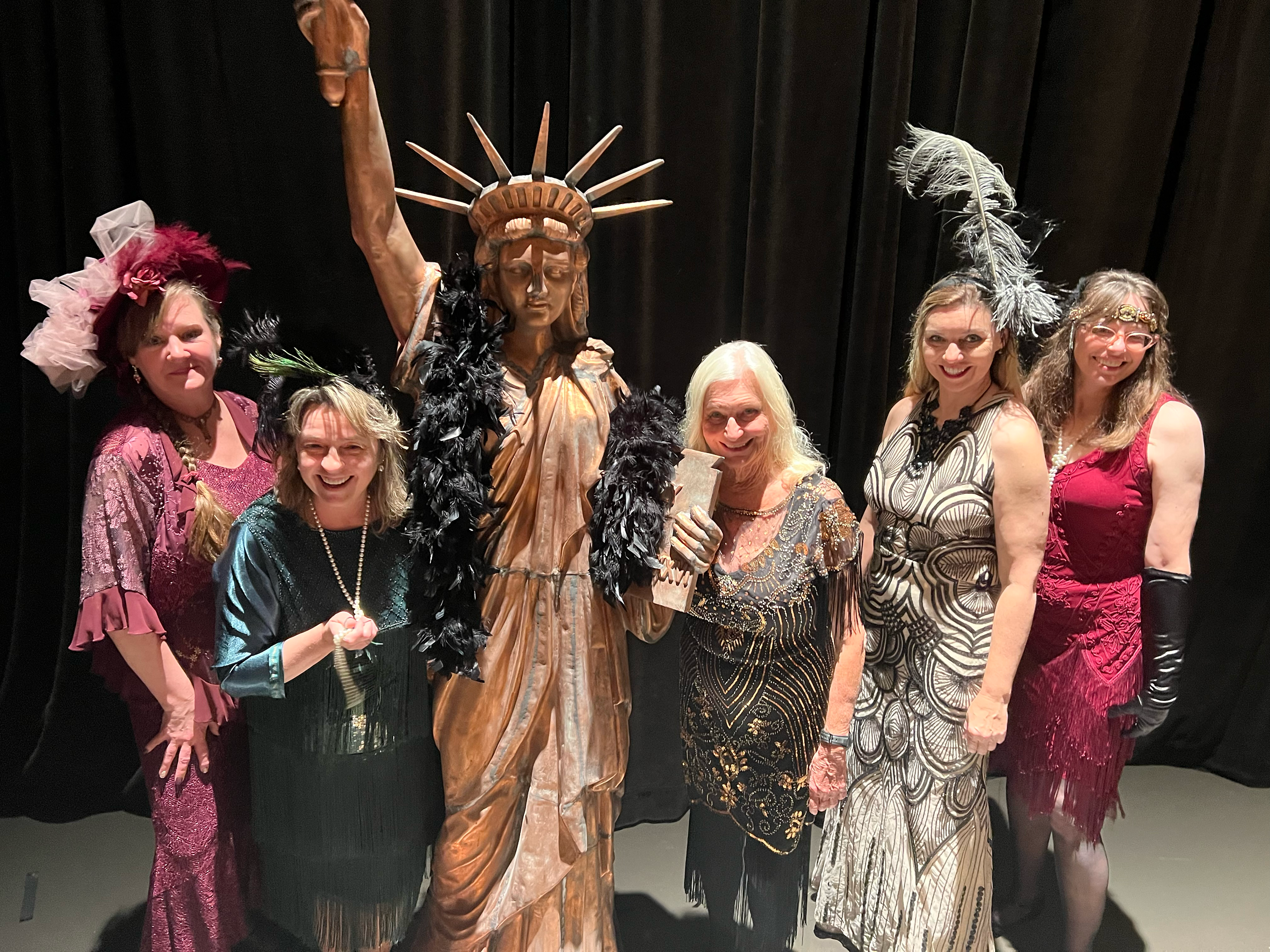
She is iconic, sweet-faced, liberty-loving, an All-American girl next door, even after seventy years of neglect. Along with the light of Democracy and Freedom she carries an impeccable pedigree and a sketchy province.
How the Little Sister of Liberty came to be in Juneau, and why she was rejected by the Capitol city and the State of Alaska when she was received with great honors and respect at over 200 other locations around the county is a mystery to be solved. Her final resting place is yet-to-be resolved.
Backstory
A strongly divided America was shivering under the icy shadow of political unrest in 1950. The country was being torn apart at the seams - tattered by the Red Scare of communist paranoia and dramatic civil unrest, unraveled by the Korean War and the Cold War.
In an effort to boost patriotism and appreciation for American values, the Boy Scouts of America (BSA) launched their “Strengthen the Arm of Liberty” campaign. The first initiative was the successful Little Sisters of Liberty project launched at the 40th-anniversary Jamboree and credited with a 33% growth in Scouts membership.
“Americans, more than ever before, need to be reminded that freedom, like life itself, is preserved only through vigilance and care,” contends BSA Council Commissioner Jack P. Whitaker in the Little Sisters pamplet. 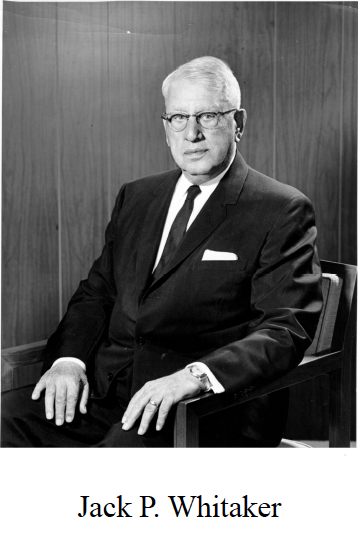
Whitaker pulled $3,500 ($43,540.00 USD 2022) from his pocketbook to have an original mold made for the Little Sisters of Liberty statues after attending the dedication ceremony for a chicken wire and concrete Statue of Liberty replica in Spirit Lake, Iowa.
'The one difference between the replica and the original in New York harbor is that the replica is a smiling statue - the curvature of the mouth has been modified from that of the original,” reported The Gazette of Iowa.
A Chicago-firm, the Friedley-Voshardt Company, created the statues by applying over 40 sheets of nickel-thick stamped copper to a handcrafted wooden frame.
A dramatic torch-lighting ceremony was held beneath the Statue of Liberty to kick off the initiative. Boy’s Life reports it was broadcast live via radio halfway around the world to over two million Scouts. President Harry A. Truman and General Dwight D. Eisenhower offered remarks.
Over the next few years, a reported 206 Little Sisters of Liberty appeared in communities in 39 states, Guam, Puerto Rico, the Panama Canal Zone, and the Philippines.
Boy Scout troops raised funds and purchased the statues for $300-350 ($4,354 USD 2022), then donated them to their city according to the July 1950 edition of The Scout Executive.
Coming in around 8’4”, the Little Sister’s soft-metal sheeting was easily damaged. Since they weighed under 200 lbs - the statues knocked-over easily, so many receiving communities created elaborate pedestals and landscaping to protect them.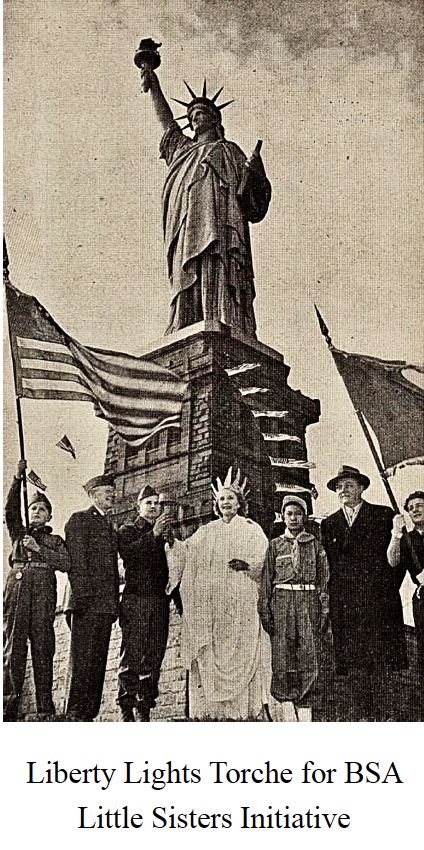
Juneau’s Daily Alaska Empire ran remarks from President Truman’s address at the opening ceremony and a “Boy Scout Week” story, both of which referenced the Little Sisters Initiative with no mention of any Alaskan participation.
It would have been a front page story, as many Scout activities were in over 1,450 BSA stories that ran in Alaskan newspapers during the time the Little Sisters initiative ran.
The exceptionally politically strong Alaska Council of the Boy Scouts of America was established July 1, 1947, with the inception of Juneau’s Nanuk Lodge #355.
Former Governor George A. Parks served as it's president during the time of the Little Sisters initiative and he was given the BSA’s highest award, the Silver Beaver, at the Jamboree. Two of the most influential businessmen in the history of the state, Bob Atwood and Elmer Rasmusson volunteered their support.
Full time BSA field executives Russell A. Apple of Fairbanks, Duane Huntly, and Anchorage’s Harold Gribble formed the founding leadership of the troop, with a focus on establishing a strong Sea Scouts program with assistance from the US Coast Guard according to the Daily Alaska Empire.
The Seward Seaport Record reports that Juneau’s Curtis Shattuk was chair of the 40th anniversary committee, and that 37 Alaska Scouts and five leaders attended the Valley Forge Jamboree.
They marked the entry to their camping site with two genuine totem poles lend to them by the curriator of the Territorial Musuem in Juneau, Edward L. Keithahn, from his personal collection. It was the first time an official delegation from Alaska attended the event.
John Jensen and POA Juneau Igloo member Thomas Cashen (1935-2019) of Douglas Troop 610 and Eagle Scout Arthur McKinnion, Gerald Shaw, Richard Klingbell, Donald MacKinnon, JR, Gregory Ripke, Robert Ripke, and Eagle Scout Edward Dull of the Juneau Troops 713, 623 and 613 were selected as attendees from the 446 members of the Gastineau District.
President Truman and General Eisenhower offered remarks, the journey took a month and included stops in New York and Washington DC.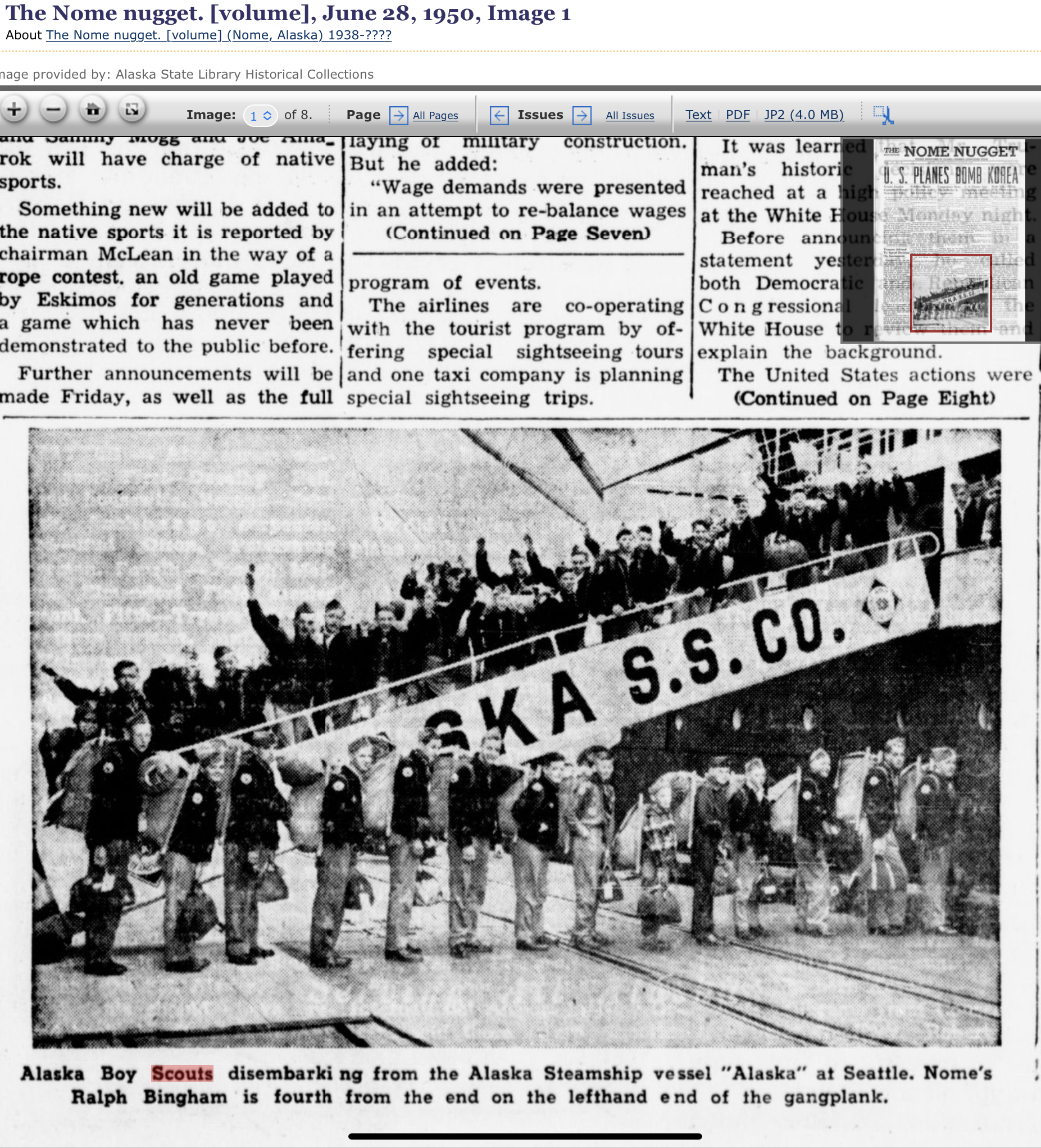
Rumors spread that the Alaska-Hawaii staehood bills had passed and we're awaiting Truman’s signature, so the Alaska scouts started work immediately on a tremendous scaffold to hang Texas in effigy as the largest state. They were totally pranked.
Many of the boys saw television and live snakes for the first time and watched the Boston Red Sox best the NY Yankees according to the Seward Seaport.
Juneau Mayor concurrent Territorial Representative Waino Edward Hendrickson (1896-1983) issued a proclamation creating Boy Scout week and urging citizens to recognize the unselfish patriotic service rendered to the community by the BSA volunteers.
Hendrickson later served as Alaska’s last territorial governor and as the 1965 Grand Igloo President of the Pioneers of Alaska. Kodiak Mayor Lee Bettinger and Seward Mayor Eugene Lanier issued a similar proclamation.
In celebration, the scouts participated in a window decoration contest, the American Legion hosted an event honoring them, and the scouts make a point of wearing their uniforms to church on Sunday.
By February of 1950, the Alaska BSA headquarters had moved from Juneau to Anchorage according to the Valley Settler. A WW2 Navy veteran, Doermus Platt Scudder, was listed as Lodge Advisor in the 1950 census, working full-time from 1949-51 as a field executive for the BSA and living in Ketchikan. The Valley Frontiersman reported that there were 2,128 Scouts in Alaska in January of 1950.
Revival
Over half of the Little Sisters, which envisions Bartholdi’s Liberty Enlightening the World as a young woman, had disappeared by the 9-11 attacks.
“Weather and vandalism took a toll. Spikes were broken from the crown and the torch-carrying arm often was damaged,” reported Marti Attiun for Scouting Magazine in October 2007. “While some cities faithfully restored the statues, others simply junked them.”
In 1998, Cheyenne, Wyoming Troop 101 launched a national treasure hunt to locate what remained of the estimated 200 little Statues of Liberty by setting up a clearinghouse website to track the conditions and whereabouts, and a Facebook page.
Another list of remaining Little Sister can be found at the Historical Marker Database, Wonders of the World, and in the Smithsonian American Art Museum registry and the National Register of Historic Places.
Alaska is not listed in any of the databases, as the whereabouts of Juneau’s statue remained a mystery for over three decades.
Mayor/Territorial Governor Hendrickson developed Juneau, leading the city to become the first city in Alaska to be fully paved. He was one of the most influential men of his time, and a strong supporter of BSA.
So it is curious that when the City of Juneau received one of the statues in 1951, Hendrickson could not be found even making a mention of it and the statute appears to have never been erected. Since that time, she has had quite a history.
Little Sister was located in a sand storage building at the Juneau Airport in the early 1970’s, where she was destined for the garbage dump.
It was rescued and stored at the National Guard Armory until the early 1990’s, when Little Sister was turned in to the state surplus for disposal.
The statue was purchased by a member of the Pioneers of Alaska Men’s Igloo 6. but unfortunately it was stored outside and over the years was transported in many 4th of July parades and other events in the back of a pickup truck. 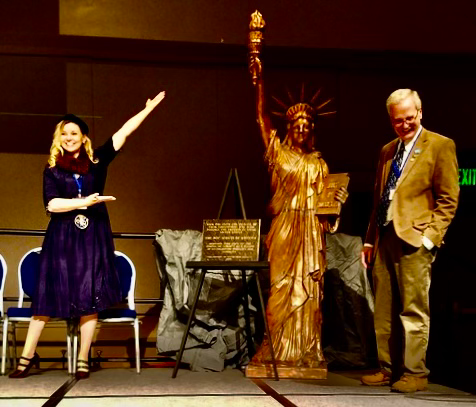
Over time, many of the lead soldered seams and the spikes on the crown separated, multiple cracks and dents developed in the copper sheeting, and the torch arm became twisted. The statue was donated to Juneau Men’s Igloo 6 in 2010.
In 2022, she was fully restored by Men’s Igloo 6 member Brad Austin and he, Statue Savior Fred Thornsteinson, and Women's Igloo President Dorene Lorenz presented her Juneau Mayor Beth Waldon at the Grand Igloo Convention with the understanding that she would be properly displayed in public,and the Igloo had reserved funds for a pedestal. The statue was held in Juneau City Manager Rorie Watt's office in 2024, and moved to Mayor Beth Weldon's office after he left the CBJ.
As part of our America250 projects, the Pioneers would like to purchase a museum-quality case and stand for the statue and install it at an appropriate space in the Juneau Airport. Funds have already been appropriated by the Pioneers, and we are awaiting the City's determination of where to place her.
Fun Facts
Liberty, is derived from the ancient Roman goddess of freedom, Libertas, who was widely worshipped - especially among formerly enslaved people.
JULY IV MDCCLXXVI is inscribed on the tablet to associating the date of America’s Declaration of Independence with the concept of liberty.
At the 2022 Grand Igloo Convention, the Little Sister of Liberty was inducted as an honorary member of the Juneau Women's Igloo No. 9.