
Bosch, William
Property / Address: William Bosch House, 214 Dixon Street
Location: Telephone Hill Historic Neighborhood, Juneau, Alaska
Constructed: 1913–1914
Builder / Owner: William Bosch
Keywords: William Bosch House, 214 Dixon Street Juneau, Telephone Hill historic neighborhood, Garside lots Juneau
History
The William Bosch House at 214 Dixon Street sits on the west slope of Telephone Hill. The residence was constructed between 1913 and 1914 by William Bosch.
The 1894 plat map of the Juneau Townsite shows Charles W. Garside as the owner of Lots 3 and 4 at the turn of the century. Charles and his brother, George Garside, arrived in Juneau in 1884. Both men were mining engineers and early surveyors of the Juneau Townsite. George Garside was also one of the original developers of the Perseverance, Atla, and Jumbo lodes in the Silver Bow Basin.
City tax records indicate that Charles Garside sold the two lots to William Bosch in 1912. Bosch was the proprietor of the Old Stand Saloon on Front Street in 1983, located next to the 20th Century Market.
The estate of William Bosch later sold Lots 3 and 4 to Joseph Stocker in the 1950s.
Sources
Stone, 1980; DeArmond, 1967; City of Juneau tax records
Tags: William Bosch House, 214 Dixon Street, Telephone Hill, Telephone Hill Historic Neighborhood, Charles W. Garside, George Garside, William Bosch, Joseph Stocker, Juneau historic houses, Juneau townsite surveyors
Garside, Charles
Primary Name: Garside, Charles W.
Filed as: garside_charles_w
Also known as: Charles Garside
Occupation / Association: Mining engineer; Surveyor
Born:
Died:
Parents:
Spouse:
Children:
Associated places: Juneau, Alaska; Silver Bow Basin, Alaska
Property / Address: Lots 3 and 4, site of the William Bosch House, Telephone Hill, Juneau, Alaska
Keywords: Charles W Garside, Charles Garside, Garside Charles W, George Garside, Juneau Townsite surveyor, Silver Bow Basin mining engineers, William Bosch House, Telephone Hill residents
Biography
Charles W. Garside and his brother, George Garside, came to Juneau in 1884. Both were mining engineers and among the early surveyors involved in laying out the Juneau Townsite.
George Garside was one of the original developers of the Perseverance, Atla, and Jumbo lodes in the Silver Bow Basin (Stone 1980; DeArmond 1967).
The 1894 plat map of the Juneau Townsite shows Charles Garside owning Lots 3 and 4 at the turn of the century. City tax records indicate that Charles Garside sold the two lots to William Bosch in 1912.
The property later became the site of the William Bosch House, which is now recognized as part of the Telephone Hill Historic Neighborhood.
Sources
Stone 1980; DeArmond 1967
Telephone Hill Historic Site and Structures Survey
Tags: Charles W Garside, Charles Garside, George Garside, mining engineers Juneau, Juneau Townsite surveyors, William Bosch House, Telephone Hill residents
Telephone Hill Historic Neighborhood
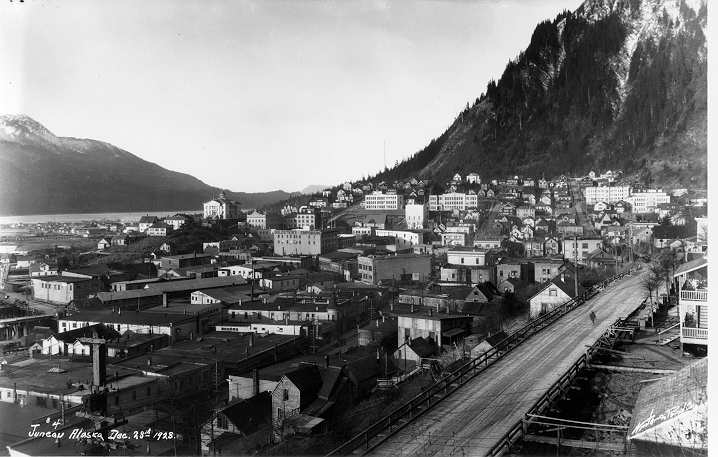
Telephone Hill is one of the oldest, continuously occupied areas in Juneau, and was part of the original Juneau Townsite Survey. The Pioneers of Alaska Juneau Igloo voted unanimously to formally request that the City and Borough of Juneau preserve this historic neighborhood.
In 1881, the U.S. Navy established a government reservation on the northern portion of the hill and constructed a military post. The hill's geographic prominence provided the Navy with a strategic vantage point from which they could maintain law and order in the raw mining town.
After the Navy abandoned the post, two government court houses were erected on the reservation beginning in 1893, and completed by the ·General Land Office in 1894. The first court house, erected in 1893, burned in 1898. The second court house was constructed in 1904, and remained on that site until razed for the construction of the present State Office Building.
Turn-of-the-century photographs of the townsite show residences on the hill, a few of which still exist today. With its sweeping view of Gastineau Channel and Douglas Island, the hill has been an attraction throughout the area’s history of habitation.
The neighborhood lies south of Third Street and is bordered by Main Street and Willoughby Avenue. The upper portion, north of Third Street, was once the location of the Government Court House until the late 1960’s. Today the State Office Building occupies the site.
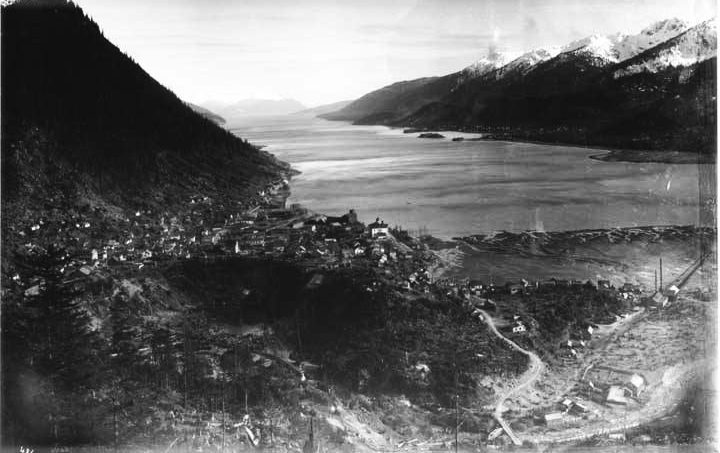 The name Telephone Hill became firmly attached to the area when Edward Webster, owner of the Juneau and Douglas Telephone Company, located his business on the summit of the hill. The business remained in the Webster house until the 1957, when POA Charter Member Anna Webster, who was running the company after his husband's death, passed away.
Several long-time Juneau businesses were situated in the study area. Attorneys Edward Bayless and Lewis Shackleford had a law library in the Edward Bayless house on Telephone Hill. The 1914 Sanborn map notes that the offices of the Pacific Coast Steamship Company and Wells Fargo Express were located in a building south of First and Main Streets.
The Winter and Pond Photography Studio, the U.S. Cable Office, and the Juneau & Douglas Telephone Company were located in the Horseshoe Building at the corner of First and Main. Empire Printing was located between First and Second on Main Street. The Alaska Road Commission had a barn and stables at the base of the hill.
The Telephone Hill Historic District is threatened with destruction as most of the development plans proposed to the City and Borough of Juneau in 2023 called for bulldozing all the historic structures. See 3 January, 2024 Anchorage Press Article for details.
Structures in the Telephone Hill Historic District:
Districts are generally groupings of buildings or structures whose significance can be other than historical visual, architectural and environmental. Groups of buildings can create a specific environment physically and spatially by representing the standards and tastes of a community or neighborhood during a period of history. Unrelated structures often collectively display a progression of styles and functions or cohesive townscapes.
The structures at the Telephone Hill summit, constructed between 1882 and 1939, are collectively significant and create a district. Two factors contribute to the district's significance: The site's association with the early development of Juneau; and the buildings' architectural details reflecting the changing construction designs during the past century. Using National Register criteria, the Telephone Hill structures were determined in the Telephone Hill Historic Site and Structures Survey, 1984, to meet the qualifications of the National Register of Historic Places for a Historic District.
CBJ Telephone Hill Redevelopment Documents
Juneau Telephone Hill Market Analysis, Feasibility Analysis and Development Strategy